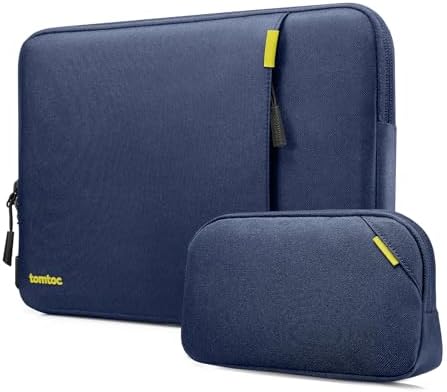
Buyers who want to protect a single laptop inside a backpack or travel bag get the most from the tomtoc 360 Protective Laptop Sleeve. This sleeve adds more padding than a minimalist option, so expect extra bulk. The most common mistake is choosing a size based on the screen label alone. Chassis width, depth, any hard shell, and the host bag’s spare thickness all shift the fit.
Buyer reports link the soft lining, reinforced edges and corners, and thick padding with a more secure carry. That same build makes the sleeve bulkier, so host-bag fit gets tighter, and device tolerances shrink, especially for 14-inch laptops.
Product Snapshot
Treat this sleeve as a padded layer for protection, with a separate pouch for accessories. It is not a stand-alone laptop bag.
| Product detail | Decision relevance |
| 13-, 14-, 15-, and 16-inch device-fit variants | Screen size is only a starting point; chassis dimensions and proportions still matter. |
| Stated internal dimensions: 13-inch 11.97 × 8.46 × 0.61 in; 14-inch 12.31 × 8.71 × 0.61 in; 16-inch 14.01 × 9.77 × 0.66 in | Useful for screening fit, but buyer and seller reports do not support treating these numbers as a guarantee. No reliable 15-inch internal-dimension figure is available in the evidence. |
| Main sleeve + zippered front pocket + separate accessory pouch | The pouch is repeatedly used for chargers, mice, cables, SSDs, and hubs, while the sleeve pocket works better for thin or flat items. |
| Padded edges/corners and soft interior | Buyers repeatedly report protection-positive carry, but the evidence does not establish a laboratory drop rating. |
| No built-in shoulder-strap attachment; buyers also mention the absence of a grab handle | Better suited to carrying inside another bag than replacing a dedicated laptop bag. |
| Seller describes the sleeve as water-resistant | Specific buyer rain reports are positive, but the evidence does not establish waterproof or submersion protection. |
Buyer Evidence Metrics
Device-fit boundaries, the padding-versus-bulk trade-off, and accessory placement are the main buyer signals.
| Buyer Question | Metric | Evidence |
| Does 14-inch protective padding usually come with a thickness or host-bag trade-off? | TCR 0.71 | Limited · n=7 |
| Do the stated 14-inch dimensions form a clean fit boundary? | UBC 0.40 | Limited · n=5 |
| Is the 15-inch class more consistent for its intended device size? | UBC 0.83 | Limited · n=6 |
| Is the 16-inch fit boundary more consistent for slim 16-inch-class laptops than for deeper chassis? | UBC 0.83 | Moderate · n=12 |
| Does the separate pouch repeatedly pair with a limit on bulky hard items in the sleeve pocket? | TCR 1.00 | Limited · n=7 |
The 14-inch sleeve is the main caution zone. Exact-dimension evidence does not split cleanly between fits and does-not-fit. The 15- and 16-inch sleeves show more consistent patterns, but exceptions still show up.
A TCR 1.00 pouch signal does not require every buyer to use the pouch. It means all seven eligible buyer reports that looked at this strength–friction pair found the pouch useful when the sleeve pocket hit a practical limit for hard or bulky items.
How these metrics work:
- Use Boundary Consistency (UBC) measures how consistently eligible buyer evidence separates a supported use case from the condition where that use becomes more limited or conditional.
- Trade-Off Coupling Rate (TCR) measures how often an observed product strength appears together with a specific friction among eligible buyer evidence.
- n is the number of relevant, eligible, deduplicated buyer observations used for that metric—not the product’s total review count.
- These are buyer-evidence signals, not product-performance scores, probabilities, rankings, or lab measurements.
See how these buyer-evidence metrics work.
Fit–Friction Matrix
This sleeve works best when you check laptop fit first and keep bulky accessories out of the main sleeve body.
| Buyer Setup / Context | Fit Signal | Main Friction |
| 13-inch-class laptop near the stated internal envelope, carried inside a backpack | Generally Works | Dimensional tolerance is narrow; some 13.5- to 13.6-inch-class devices become snug or move into a larger-size decision. |
| Bare 14-inch-class laptop + backpack + separate pouch for charger and mouse | Generally Works | Thick edge protection can tighten the fit inside a medium backpack or cabin bag. |
| 14-inch laptop with a hard shell or chassis near the sleeve’s width/depth limits | Mixed / Variant-Dependent | Buyer reports range from workable to too tight to close, so the shell and chassis dimensions materially change the result. |
| MacBook Air 15-class laptop carried inside a backpack | Generally Works | Most reports describe a close fit, but excess internal length appears in one case and upsizing a smaller device can create play. |
| MacBook Pro 16 and similarly slim 16-inch-class laptops | Recurring Strong Fit | Overall footprint is larger, and deeper or wider 16-inch gaming/business chassis can cross the practical fit boundary. |
| Charger, mouse, cables, or SSDs separated into the accessory pouch | Recurring Strong Fit | Very large power bricks can exceed pouch capacity; the sleeve’s front pocket is less suitable for bulky hard items. |
Variant Fit Patterns
Pick the variant based on your laptop’s actual size and how you plan to carry it. Do not rely on the screen label alone.
- 13-inch: The internal size is 11.97 × 8.46 × 0.61 inches. Compact laptops close to those numbers usually fit, but MacBook Air 13.6 results are split between fits and snug/tight. This sleeve runs close to the limit and isn’t roomy.
- 14-inch: This size has the most buyer evidence and the least clear boundary. A bare 14-inch MacBook Pro and similar laptops often fit, but add a hard shell or push the device near or past the 12.31 × 8.71 × 0.61-inch envelope and results get mixed. UBC 0.40 shows this inconsistency. That is not a 40% fit rate.
- 15-inch: MacBook Air 15 fits are mostly stable and close, so the fit boundary is more predictable. One buyer did report extra length, and putting a smaller 14-inch laptop in the 15-inch sleeve left about 2 cm of side play. No reliable internal-dimension number for the 15-inch sleeve shows up in the evidence.
- 16-inch: MacBook Pro 16 buyers give the clearest pattern for large devices. The 14.01 × 9.77 × 0.66-inch envelope works as a warning for deeper or wider gaming and business laptops. Seller Q&A still lists exceptions where over-envelope devices fit.
The Padding Is the Strength—and the Bulk Trade-Off
Buy this sleeve for the reinforced protection, not for slimness.
Buyers across all sizes point to the soft interior, padded sides, and reinforced corners as reasons their laptop feels safer in a backpack or travel bag. The trade-off shows up when you try to fit the sleeve into a tight laptop compartment. A medium backpack and a Briggs & Riley cabin bag both fit more tightly with the 14-inch sleeve’s padding.
One backpack user might call the sleeve slim enough, while another finds it bulky compared to a neoprene slip case. The host bag usually explains the difference, not a flaw in the sleeve itself.
Use the Separate Pouch for Hard Accessories
The two-piece setup works best if you keep the sleeve flat and move the charger, mouse, and other hard items into the separate pouch.
Recurring buyer setups place chargers, cables, mice, SSDs, hubs, and small adapters in that pouch. Examples include a UGREEN 100W USB-C charger, Samsung T7 Tuff SSD, MX Anywhere 3 mouse, 8Bitdo controller, USB-C hub, and Pebble mouse.
Buyers use the front pocket for thin items like cables, dongles, papers, or a mouse pad. Hard or bulky objects in that pocket led to complaints about lumpiness, tightness, or pressure against the laptop.
The accessory pouch has a limit. In a 16-inch Zephyrus setup, a 240W charger would not fit, but a 100W USB-C charger did.
This sleeve works better as extra protection inside another bag than as a stand-alone carry solution.
The sleeve’s most established role is extra protection inside a backpack, cabin bag, school bag, or travel setup.
Buyers use the sleeve inside backpacks, cabin bags, school bags, and travel setups across all sizes. Some do use it alone, but there is no evidence showing a shoulder-strap attachment. Several buyers wanted a handle or a way to attach the pouch.
Weather resistance is a bonus, not the main reason to buy. The seller calls the material water-resistant, and some rain-use reports found the interior stayed dry. Still, it is not waterproof or submersion-proof.
What Buyers Compare It With
Buyers compare this sleeve to slimmer, cleaner sleeves, not to feature-heavy options. The real trade-off is structure and padding versus minimal bulk.
| Compared product | What changed the buyer decision |
| Native Union Stow Slim | One 14-inch buyer viewed it as slimmer with magnetic closure, but chose the tomtoc for lower price and corner protection. |
| Amazon Basics equivalent sleeve/pouch | One buyer preferred the sleeker look of the alternative but regarded the tomtoc as more padded. |
These are individual comparison contexts, not evidence that one product is universally better.
What Buyers Should Check Before Buying
A few checks matter more than the screen label.
- Measure your laptop’s width, depth, and thickness. Treat the stated internal dimensions for the 13-, 14-, and 16-inch sleeves as a starting point, not a guarantee. Buyer evidence includes both over-envelope fits and cases where a device inside the envelope still did not fit.
- Check for a hard shell. The 14-inch sleeve sometimes fits with a shell and sometimes will not close. Do not assume a bare-laptop fit means your setup will work.
- Check how much spare thickness your host bag has. The padding might fit fine in one backpack but feel tight in another, especially in structured laptop compartments or cabin bags.
- Keep bulky or hard accessories out of the sleeve pocket. Use the separate pouch for chargers, mice, SSDs, hubs, and cables. Very large power bricks may still be too big for the pouch.
- Decide if you need stand-alone carry features. The evidence supports this as a protective sleeve first. No built-in shoulder-strap attachment is established, and buyers often mention the missing handle or carry solution.

Want to see how the tomtoc compares with slimmer and more structured options? Compare it in our Best Laptop Sleeves roundup →
