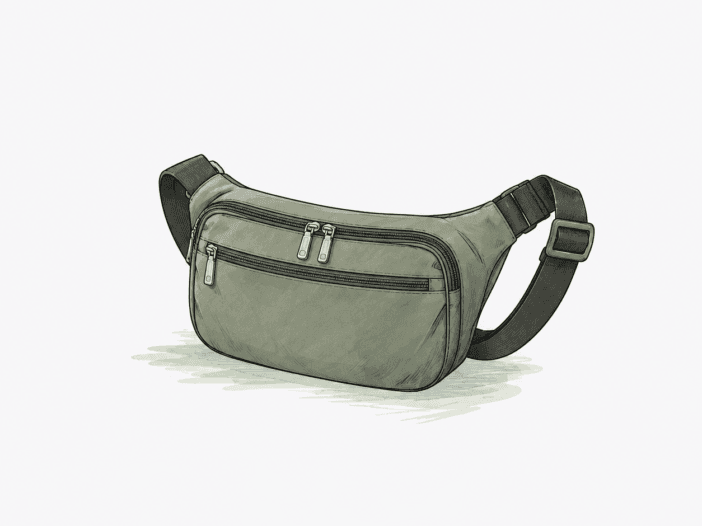
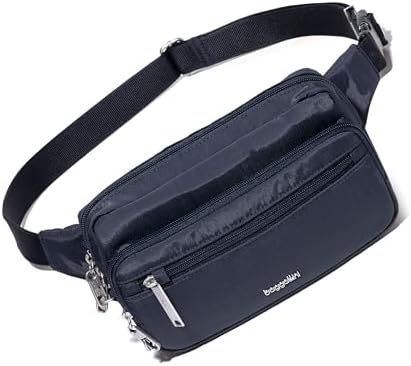
The Baggallini Securtex Belt Bag Sling works best when you keep the load simple: phone, passport, cards or wallet, keys, a compact battery pack or charger, and a few small personal items. Buyer reports repeatedly support this kind of hands-free travel or errand setup, with the pockets and locking zippers handling most of the organization.
The main friction shows up at the body: smaller-waist fit and buckle position get more conditional, and capacity becomes less predictable if you add more than the basics.
Decision Snapshot
| Decision Area | What Buyer Evidence Suggests | Main Boundary |
| Cleanest fit | Compact travel and everyday essentials are the most consistently supported role | Expanded immediate-access loads become more conditional |
| Configuration | The available evidence supports one One Size family; color does not change the decision | Body size and carry position matter more than color |
| Waist fit | Mid-size examples such as about 34 inches, size 12, size 16/18, and plus-size use generally work | Around 30 inches and below, several buyers report excess strap or insufficient tightening |
| Carry mode | Waist carry and front/chest crossbody use can both work | Crossbody use becomes more sensitive to buckle position, protrusion, strap length, and zipper orientation |
| Security pattern | Buyers repeatedly value locking zipper features and security-focused organization | The main quick-release buckle does not have the same locked behavior, according to recurring buyer reports |
| Phone and small-tech access | Phones and compact tech fit in several real loads | The smallest front pocket is device-, case-, and load-dependent |
Does It Match Your Setup?
| Buyer Setup / Context | Fit Signal | Main Friction |
| Passport + phone + cards/wallet + keys + compact charger or battery pack | Recurring Strong Fit | Adding more immediately accessible gear begins to consume the compact-carry advantage |
| Mid-size waist examples in the buyer evidence | Generally Works | No recurring friction established in the available buyer evidence |
| Petite or roughly 30-inch-and-below waist needing a snug belt fit | Conditional Fit | Several buyers could not tighten the One Size strap enough, although one size 2–4 Q&A example reported a workable fit |
| Crossbody or shoulder carry | Conditional Fit | Buckle position, clasp protrusion, strap length, and zipper orientation change the experience |
| Security-priority travel or crowded settings | Generally Works | Some buyers treat the quick-release buckle as the weak point and change its position or add their own restraint |
The real question is not whether the bag can hold a lot, but whether you keep your load disciplined. Once body fit, buckle position, or extra gear start to matter more, the decision gets more conditional.
Compact essentials are the clearest fit. Adding extra gear changes how the bag works much faster than just carrying the basics.
Buyer evidence is strongest for a compact travel load, not as a full-day catch-all. Passports, phones, cards, wallets, keys, and small chargers repeatedly fit without turning the bag into a purse or backpack substitute.
The boundary is not fixed. One buyer fit a Kindle for NYC travel, another fit a small iPad occasionally, and one event setup included two phones and two digital cameras. These are useful exceptions, but they are too specific to treat as reliable capacity templates for other devices or packing styles.
Phone placement is especially conditional. One Q&A report said a cased Galaxy Note9 did not fit the smallest front pocket, while another buyer fit a Google Pixel 8 there snugly. Other buyers just used a larger compartment for the phone.
The One Size strap fits more predictably through the middle of the range than at the small end.
Body fit is the clearest thing to check before buying. Buyers around a 34-inch waist, size 12, size 16/18, and plus-size examples reported workable or comfortable fit. Several smaller-waist users described the minimum setting as still too loose.
The small end is not consistent. One size 2–4 Q&A response said the strap could be tightened enough. A 30-inch-waist buyer said the bag could be pulled down over the hips. A 27-inch-waist buyer shortened the belt a lot, and a 5-foot-1, 100-pound buyer improvised a different strap arrangement.
Q&A lists a 32–50-inch adjustable strap range. Buyer reports show this is not a universal body-fit guarantee. Actual fit depends on how the bag sits, how tightly you want it to stay in place, and whether you wear it at the waist or across the body.
Security-focused organization is strongest when the main buckle stays under your control.
Locking zipper features and other security elements are recurring reasons buyers choose this bag. The important counterweight is that many buyers don’t see the main quick-release buckle as equally protected.
How you wear the bag changes that concern. Some buyers reported no buckle problem in actual travel, especially when the clasp sat toward the front, chest, under an arm, or beneath clothing. Others added a zip tie or coated wire loop because they did not want the main buckle to remain a single quick-release point.
Crossbody wear deserves its own fit check. It worked well for several travelers, but other reports describe a buckle that sticks out, a clasp that does not lie flat, a strap that can be borderline short for crossbody use, or zipper orientation that favors one side of the body.
Buyer Evidence Signals
| Buyer Question | Practical Reading | Evidence Signal |
| Is smaller-waist fit meaningfully less predictable? | Yes. The evidence separates mid-size fit from smaller-waist friction fairly consistently, but one size 2–4 example prevents a hard cutoff. | UBC 0.90 · Moderate · n=10 |
| Does the bag have a clear compact-load boundary? | Compact day and travel loads show the cleaner pattern; larger immediate-access loads become more conditional, although a few larger tech loads still worked. | UBC 0.87 · Moderate · n=15 |
| Do security-focused strengths often appear alongside concern about the main buckle? | The pairing recurs across eligible evidence, but it does not mean the security features cause the buckle concern, and several buyers report secure actual use. | TCR 0.69 · Moderate · n=13 |
| Is buckle or clasp friction more concentrated in crossbody/shoulder use? | Slightly in the eligible evidence, but the comparison is limited and both carry modes include positive and negative examples. | CFL 1.19× · Limited · n=5 |
- UBC: how consistently eligible buyer evidence separates a supported use from the condition where it becomes more limited or conditional.
- TCR: how often an observed strength appears together with a specific friction among eligible buyer evidence; it does not establish causality.
- CFL: whether a known friction is more concentrated in a defined context than in the eligible baseline; it is not a severity score.
- n: relevant, eligible, deduplicated buyer observations used for the metric—not the product’s total review count. For CFL, public n is the smaller eligible comparison group.
These are buyer-evidence signals, not product-performance scores or probabilities. See how these buyer-evidence metrics work.
Real buyer loads show where the compact format stretches—and where it does not.
These are observed buyer examples, not guaranteed capacity templates.
European sightseeing load
Two passports · battery pack · iPhone 16 · lip balm · mini hand lotion · compact wallet · pen · hair clip
→ The complete sightseeing load fit in one buyer’s setup, supporting the compact-travel role without needing a larger bag.
Family passport load
Four passports · iPhone 16 · headphones case · cards · eyeglasses · portable charger · small personal items
→ The load fit, but the smallest front pocket was too small for the phone. The same buyer added a zip tie because the main buckle did not lock.
Event tech load
Two phones · two digital cameras · small extra items
→ One buyer carried this load at Coachella and described the bag as compact and lightweight. This is a useful upper-end example, but the evidence is too sparse to treat multiple-camera carry as a standard capacity expectation.
What Buyers Should Check Before Buying
- Measure your actual waist carry position. If you are around 30 inches or below, do not assume the One Size adjustment will get snug enough. Buyer evidence is mixed at the small end.
- Decide where the buckle will sit in your preferred carry mode. Crossbody reports are strongest when the clasp stays toward the front, chest, or under the arm, not behind the body.
- Test your actual phone and case against the pocket you want to use. The smallest front pocket works for some phones, but not others, and the surrounding load changes the result.
- Pack the items you need to access immediately, not just everything you travel with. Compact essentials are the clearest fit. Capacity becomes less predictable for extended-trip access needs.
- Decide whether the main quick-release buckle meets your security expectations. Locking zipper features don’t eliminate the separate-buckle concern some buyers report.
- Check crossbody strap length and clasp comfort on your body. Buyer reports include both workable crossbody use and cases where strap length, stiffness, or buckle protrusion became the deciding friction.
Baggallini Securtex Belt Bag Sling on Amazon
Its belt-or-sling carry role becomes clearer when viewed alongside the rest of Baggallini Tech Carry.
