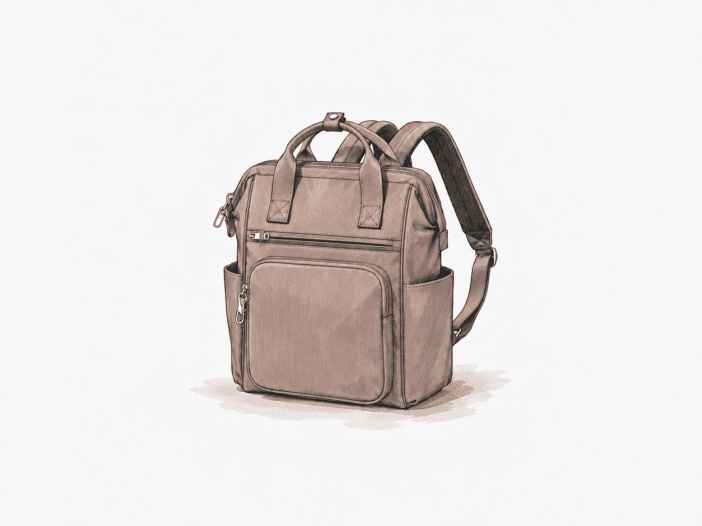
The Baggallini Securtex Windsor Backpack works best for laptop-centered travel or mobile work when you need wide top access, a luggage handle pass-through, and security-focused closures. Buyer reports cover airports, trains, crowded city transit, office commutes, and international trips. Real-world examples include a 13-inch computer, a 15-inch laptop, and one snug 16-inch MacBook.
The main catch is body fit, not just storage space. Several buyers around 5’2″ to 5’3″ or with short torsos said the straps would not shorten enough or would rub during use. Others, including a 5’4″ buyer, found the fit workable or comfortable. Capacity also gets less predictable if you move from laptop and work essentials to bulkier or extended-trip loads.
Some source records call the bag “Medium,” but no alternate size or configuration is established. The decision below therefore applies to one product family, not a size comparison.

Decision Snapshot
| Decision Area | What the Buyer Evidence Suggests | Main Boundary |
| Cleanest fit | Laptop-centered international or business travel where wide access, organized tech carry, and security-oriented closures are priorities | Strap fit should still be checked under a realistic load |
| Main trade-off | Structure and security-focused handling can coexist with quick visibility and retrieval | Strap geometry, rigid junctions, or extra closure steps create friction for some buyers |
| Device fit | 13-inch and 15-inch examples worked; one 16-inch MacBook was reported as snug | No official dimensions or universal laptop-size limit are established |
| Capacity | Laptop/work essentials are the more consistent use boundary, but several unusually large mixed loads also worked | Bulky or extended-trip loads are less predictable rather than clearly out of bounds |
| Airline use | Several buyers reported under-seat or personal-item success | One Aer Lingus regional-prop window-seat example did not fit under the seat |
| Configuration | No decision-relevant variant split is supported | “Medium” is source context only, not a basis for comparing sizes |
Does It Match Your Setup?
| Buyer Setup / Context | Fit Signal | Main Friction |
| Laptop + charger/office gear for work or mobile work | Generally Works | A 16-inch MacBook was reported as snug, and no universal laptop-size boundary is established |
| International or city travel with a laptop, essentials, and rolling luggage | Recurring Strong Fit | Body fit can become the limiting factor even when organization and access work well |
| Short or small-frame carry where the pack needs to sit close and high | Conditional Fit | Several 5’2″–5’3″ and short-torso users said the straps would not shorten enough or rubbed |
| Heavier or longer-duration carry | Conditional Fit | Narrower straps, rigid strap junctions, and total loaded weight become more noticeable for some buyers |
| Bulky or extended-trip mixed packing | Conditional Fit | Some loads exceeded preferred closure depth or capacity, although several high-volume counterexamples worked |
| Airline under-seat or personal-item use | Conditional Fit | Airline, aircraft, seat position, and packed state can change the result |
The real split is not just small bag versus big bag. What matters more is whether your load stays centered around a laptop and whether the harness shape actually fits you.
Strap Geometry Is the First Fit Gate for Smaller Frames
The most consistent body-fit warning comes from buyers around 5’2″ to 5’3″ or with a short torso. Several said the shoulder straps could not be shortened enough to hold the pack close to the back. Others reported underarm or torso rubbing even after adjustment.
That pattern is not universal. A 5’4″ buyer using a Medium-labeled example described the pack as stable and manageable, while other buyers reported comfortable longer carry. A 5’8″ broad-shouldered user, however, also reported rubbing and slipping, which means height alone does not explain every fit problem.
Loaded weight can make the fit issue worse. Some buyers said the bag felt light or easy to carry. Others found that a laptop plus supplies made it uncomfortable. One buyer even stopped using it after back discomfort. The practical check is how the harness fits with your actual load, not just how the empty bag feels.
Laptop-Centered Loads Are the Cleaner Capacity Boundary
The most repeatable successful setups center on a laptop plus work, tech, or compact travel essentials. Specific buyer reports include:
- a 13-inch computer with its cover, plus ordinary work items;
- a 15-inch laptop with usable room around it;
- a laptop, iPad, Kindle, cords, and chargers carried together;
- a laptop with notebooks, files, and lunch for work use;
- a 16-inch MacBook that fit snugly during city/work travel and two-airport, full-day walking.
Capacity gets less predictable when ‘travel bag’ means bulky or extended-trip packing. One buyer ruled it out for a five-week Australia trip because it was smaller than expected. Another could not close it around a lunchbox, water bottle, flip-flops, calendar, and pencil box.
Still, this is not a strict capacity cutoff. Some buyers packed it for a week-long overstuffed Europe trip. Others fit a day-trip load with a blanket, extra jacket, change of clothes, medical and cleaning supplies, water bottles, laptop, handbag, and glasses. These examples show why it makes sense to judge the Windsor by your actual load shape, not just trip length.
Wide-Top Access Is Usually a Strength; Closure Friction Is the Exception
Wide, hinged, or stand-open top access comes up often as a positive. Buyers say they can see inside, grab items quickly, arrange gear more easily, and get a laptop in or out without digging through the pack.
The same structure can create friction. One buyer compared the Windsor to a Baggallini Nolita and said the metal top frame helped the Windsor keep its shape but made opening and closing harder and limited space for larger items. Another buyer said the zipper clip could be tricky with arthritis.
Security-focused closures come up often in travel and city contexts, but the evidence supports buyer confidence and access deterrence, not proven theft prevention. One buyer expected a more obvious main-compartment lock and a detachable anchoring strap, and said that mismatch would have changed their decision.
Evidence Signals
| Buyer Question | Practical Reading | Evidence Signal |
| Does a short or small frame make carry-fit friction more relevant? | Strap/body-fit complaints are more concentrated in explicit short/small-frame contexts, although one 5’4″ Medium-labeled example was positive | CFL 2.67× · Limited · n=5 |
| Do security-oriented closures usually create an access penalty? | Security and closure friction appear together in a minority of eligible observations rather than as a general trade-off | TCR 0.20 · Moderate · n=10 |
| Does the wide or hinged top commonly make opening and closing harder? | Closure friction is uncommon among evidence praising the wide/structured opening; one frame-related exception matters | TCR 0.08 · Moderate · n=12 |
| Is there a usable boundary between laptop/work essentials and bulkier travel loads? | Most eligible evidence supports that boundary, but several high-volume successes keep it conditional rather than hard | UBC 0.75 · Moderate · n=12 |
- CFL: whether a known friction is more concentrated in a defined context than in the eligible comparison baseline; it is not a severity score.
- TCR: how often an observed strength appears together with a specific friction among eligible buyer evidence; it does not establish causality.
- UBC: how consistently eligible buyer evidence separates a supported use from the condition where it becomes more limited or conditional.
- n: relevant, eligible, deduplicated buyer observations used for the metric—not the product’s total review count. For CFL, public n is the smaller eligible comparison group.
These are buyer-evidence signals, not product-performance scores or probabilities. The 2.67× CFL, for example, describes a concentration difference in the eligible evidence; it does not mean a shorter buyer is 2.67 times more likely to have a fit problem. See how these buyer-evidence metrics work.
What Switching Evidence Reveals
| Compared Product | What Mattered | What Shifted the Choice |
| Baggallini Nolita backpack | Compactness, weight, strap length, and top-frame handling | One buyer preferred the Windsor for being more compact, lighter, and shorter-strapped, while noting that its metal top frame made closure harder and limited larger items |
| Baggallini Soho | Daily capacity and security-focused features | One buyer moved from the smaller Soho to the Windsor for more daily carrying room and added security-oriented features |
| Pacsafe, model not supplied | Main-compartment locking expectations and an anchoring strap | One buyer said the Windsor did not match those security expectations and would have chosen Pacsafe instead |
These comparisons are individual switching observations, not a ranking of the products.
What Buyers Should Check Before Buying
- Check the strap range with your normal load. This check matters most if you have a short torso, want the bag to sit high and close, or notice underarm or back contact. Broad shoulders can also change the fit.
- Measure your actual laptop. Buyer examples support 13-inch and 15-inch carry, and one 16-inch MacBook fit snugly. The available evidence does not show an official universal size limit.
- Build your real packing list before judging capacity. Laptop and workloads are the clearer pattern, but bulky daily or extended-trip loads vary a lot because load shape matters.
- Check the airline, aircraft, seat, and how you pack the bag. Several buyers used it as an under-seat or personal item, but one regional-prop window seat did not work.
- Confirm the exact closure and pocket setup if you need specific security hardware or internal zip storage. Buyer reports conflict on the main locking mechanism and whether there is an interior zippered pocket, so check those details on the current product.
Baggallini Securtex Windsor Backpack on Amazon
See how the Windsor fits within the broader Baggallini Tech Carry lineup, including its backpack, tote, and sling alternatives.
