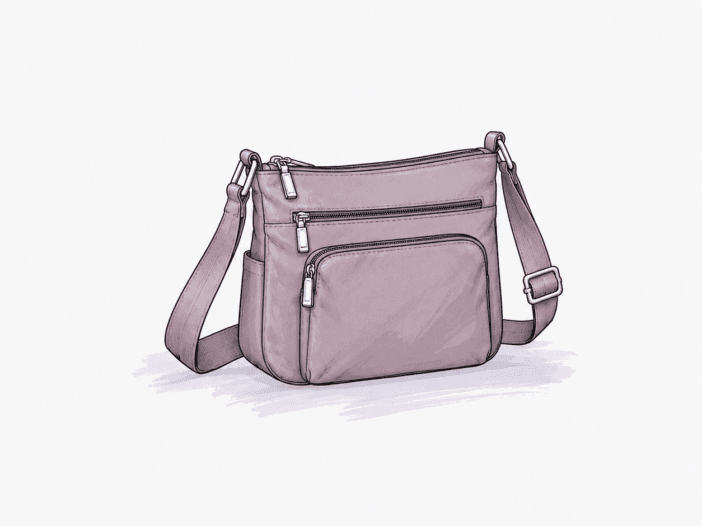
The Baggallini Take Two RFID Crossbody works best when you keep the load intentionally small: a phone, cards or ID, keys, cash or a passport, and maybe one or two compact extras. Buyer feedback keeps circling back to the same point: it separates those essentials and keeps them close without making you carry a bigger bag.
That strength has a clear limit. A large or cased phone can fit, but once you add glasses, chunky keys, cosmetics, charger gear, or other bulky items, everything starts fighting for the same shallow space. The bag organizes a disciplined load well, but it does not stretch to handle a growing list.
The strap is worth checking too. Buyer feedback on the standard narrow strap ranges from comfortable for all-day wear to digging, twisting, or feeling less secure. Some reports mention chain or metal strap versions, but the evidence doesn’t map every finish to a specific strap, so you cannot assume they all behave the same.

Decision Snapshot
| Decision Area | What the Buyer Evidence Suggests | Main Boundary |
| Cleanest fit | Phone + cards/ID + keys + cash or passport + one or two small extras | Bulky additions consume the remaining flexibility quickly |
| Large-phone fit | Many large and cased phones fit successfully | Case thickness and the rest of the load matter more than the phone model alone |
| Organization | Two zippered sections and quick-access pockets repeatedly help separate phone, cards, cash, and small items | Tight packing can make pockets and retrieval less convenient |
| Strap / body fit | The narrow strap supports very light crossbody carry for some buyers | Comfort and security perception are mixed, especially on longer wear |
| Configuration / RFID | One Size is the clearest family scope; RFID storage is part of the product evidence | Some strap/hardware configurations differ, and the exact RFID-protected area is not consistently established |
Does It Match Your Setup?
| Buyer Setup / Context | Fit Signal | Main Friction |
| Phone + cards/ID + keys + a few small essentials | Recurring Strong Fit | Adding thicker items quickly reduces spare room |
| Large or cased phone + mostly flat essentials | Conditional Fit | A thick case or bulky companion items can make the phone and pockets feel tight |
| Travel day with phone + passport(s) + cards + small personal items | Generally Works | Glasses, several passports, or other bulky items can consume the remaining margin |
| Phone + glasses + chunky keys, cosmetics, or charger gear | Limited Fit | Shallow depth can crowd the pockets and make retrieval harder |
| Extended wear with the standard narrow strap | Mixed / Variant-Dependent | Some buyers report comfortable wear; others report digging, twisting, or lower security confidence |
| Small tablet, water bottle, or bulky full-size wallet | Limited Fit | These sit outside the clearest compact-load role |
The real pattern isn’t just whether one item fits, but how many thick items compete for the same depth. That is where the Take Two stops being simply convenient and starts feeling conditional.
The bag works best when your load stays flat, not just small.
A phone, cards, ID, cash, passport, keys, earbuds, tissues, or lip balm are the kinds of items that repeatedly align with the Take Two’s role. They can be separated across the zippered and outer pockets without asking the bag to behave like a full-size purse.
The boundary appears when the load becomes three-dimensional. Buyer feedback repeatedly points to glasses, larger key sets, cosmetics, charger gear, water bottles, tablets, and bulky wallets as the items most likely to consume the remaining usable space.
That trade-off keeps the bag compact: it doesn’t offer much depth. Buyers who want a small footprint usually get the most out of it when they stick to a disciplined packing list.
Large-phone fit depends on what surrounds the phone.
Large phones are not an automatic mismatch. Buyer reports include successful use with several large iPhone and Samsung-class devices, including cased phones.
But the phone model alone is a poor predictor. One Q&A describes a Motorola measuring about 3.5 x 7 inches in a protective case as barely fitting, with bulky keys becoming difficult to add. Another buyer reports an iPhone 15 Pro Max working in an outer compartment, but larger makeup items made the overall load tight.
There are also clean-fit counterexamples. Some large phones fit without real friction when the rest of the carry stays flat and minimal. The useful question is not just “Will my phone fit?” but “Will my phone fit with the specific items I am not willing to leave out?”
Evidence Signals
| Buyer Question | Practical Reading | Evidence Signal |
| Does the compact-load boundary stay consistent as the carry list grows? | Pared-down essentials are the cleaner fit; larger or bulkier additions make the setup more conditional, although counterexamples exist | UBC 0.85 · Strong · n=53 |
| How often does retrieval friction appear alongside positive organization feedback? | Most organization-positive evidence does not report retrieval friction, but tight or stiff access appears in a minority of those observations | TCR 0.33 · Strong · n=21 |
| Is fit/capacity friction more concentrated in explicit large or cased-phone setups? | Yes, friction is more concentrated in those setups, but several large and cased phones still fit cleanly | CFL 1.82× · Moderate · n=17 |
- UBC (Use Boundary Consistency) describes how consistently eligible evidence separates a supported in-boundary setup from the more conditional setup beyond that boundary. It is not product quality or probability.
- TCR (Trade-Off Coupling Rate) describes how often an evidence-supported strength and a specific friction appear together among eligible evidence. It does not establish causality.
- CFL (Context Friction Lift) describes whether a known friction is more concentrated in a defined eligible context than in the eligible baseline. It is not severity or probability.
- n is the number of relevant, eligible, deduplicated buyer observations used for the metric—not the product’s total review count. For TCR and UBC, public n is the eligible denominator. For CFL, public n is the smaller eligible comparison group.
These are buyer-evidence signals, not product-performance scores, probabilities, or hands-on test results. See how these buyer-evidence metrics work.
Divided organization helps until packing pressure fights the pockets.
The Take Two’s divided layout is one of the more consistent positives in buyer feedback. Separate zippered sections, card organization, and quick-access outer pockets let buyers keep a phone, cards, cash, or small travel documents from collapsing into one shared compartment.
The friction is not about how many pockets there are. It is what happens when you pack the bag tightly enough that one section starts pushing into another. Some buyers report outer pockets getting harder to use, card slots becoming less convenient to reach, or the main opening feeling tight once the internal load grows.
That distinction matters because the evidence does not support a blanket “too many pockets” complaint. Most positive feedback about organization does not mention retrieval friction; the problem shows up more when a compact layout is pushed to carry a thicker, mixed load.
Real buyer loadouts show where the margin disappears.
These are observed examples, not guaranteed capacity templates.
Dense travel essentials
iPhone 13 · four passports · comb · tissues · cards · cash · AirPods · small toiletries
The divided layout kept the travel load organized, but glasses and sunglasses had to ride outside the bag. This example shows a dense load can work when most items are flat, but rigid eyewear becomes the limiting factor.
Large cased phone with only a few extras
Samsung Note 10+ in an OtterBox case · slim ID/card wallet · house key · key fob
This minimalist setup worked, but it left little room. It is a good example of how a cased phone can fit while still pushing the bag toward its practical limit.
Capacity counterexample
One Q&A reports two phones · charger brick · two cords · headphones · cards/money · lipstick fitting together.
That matters because it keeps the capacity story from sounding absolute. It is still just one example, not evidence that every similarly dense load will fit or stay easy to access.
Why some buyers compare it with the Baggallini Bryant
The Bryant appears in buyer comparisons because the Take Two keeps a similar minimalist role while adding a little more room and a second zippered section. One buyer specifically describes the extra size as enough to make newer, larger phones easier to carry.
The switch isn’t always one-way. Another buyer preferred the original Bryant’s softer, more flexible outer pouches. The comparison is useful at a narrow decision point: the Take Two gives you a bit more divided capacity. At the same time, the older Bryant can still appeal if you want softer, more flexible outer access.
The standard narrow strap is a trade-off, not a settled comfort verdict.
Strap feedback is genuinely mixed. Some buyers report comfortable all-day and hot-weather use, while others mention neck or shoulder pressure, twisting, or switching to a wider strap.
Security expectations add another layer. Some buyers find the strap fine for everyday use, while others skip it for travel because they want something thicker or more cut-resistant. The available evidence does not establish the standard strap as slashproof.
Configuration matters too. Some buyers mention chain or metal-accent strap versions with different adjustability or feel, but the evidence does not reliably map those setups to specific finishes. Do not assume every color or hardware treatment comes with the same strap behavior.
What Buyers Should Check Before Buying
- Measure your phone with its case, then add the rest of your actual load. Large-phone compatibility gets much more conditional once glasses, chunky keys, cosmetics, or charger gear share the same shallow space.
- Check the exact strap and hardware on the finish you are buying. Standard-strap evidence points to a narrow, removable, and adjustable setup, but chain or metal configurations differ.
- Decide if a narrow strap matches your comfort and security expectations. Buyer feedback ranges from comfortable extended wear to digging, twisting, and a preference for a thicker replacement.
- If RFID protection matters to you, check which area is actually protected. The evidence supports RFID storage but doesn’t consistently show whether protection covers one section or more.
- Treat a water bottle, small tablet, or bulky full-size wallet as outside the cleanest-fit role. If any of those are non-negotiable, the Take Two’s compactness is more likely to become the constraint than the benefit.
Baggallini True Classic Take Two RFID Crossbody on Amazon
For more Baggallini options serving different carry needs, browse our Baggallini Tech Carry brand overview.
