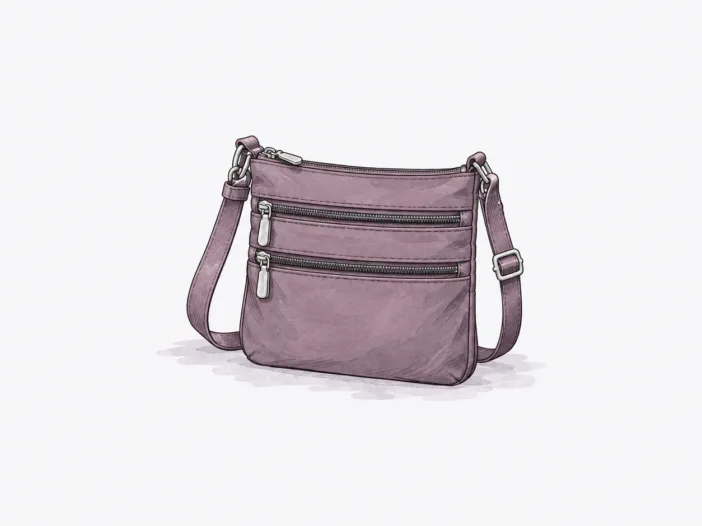
The Baggallini Triple Zip Bagg fits best if you want to carry only the basics: a phone, cards or cash, a slim wallet, keys, sunglasses, medication, and other small essentials split across zip sections. Buyer evidence repeatedly supports this compact everyday and destination-day use, including hands-free travel and dropping the loaded bag inside a larger tote or carry-on.
The trade-off is straightforward: the small footprint works because it splits up limited space. If you add extra wallets, a large cased phone, a full-size toiletry item, or a tablet-class device, one pocket can start eating into the space another pocket needs. Slim Strap evidence helps, but it is not a verdict on every strap setup since much of the strap and attachment evidence comes from versions that are not clearly identified.

Decision Snapshot
| Decision Area | What the Buyer Evidence Suggests | Main Boundary |
| Cleanest fit | Compact daily or travel essentials kept in separate zip sections | Bulky or redundant items compete for the same limited depth |
| Main trade-off | Small-item organization without the bulk of a larger bag | Limited open-ended expansion once the load grows |
| Device boundary | Phones and several Kindle-class e-readers appear in workable setups | Q&A reports do not support iPad mini 6 or full-size iPad fit |
| Carry configuration | Slim Strap examples support low-bulk crossbody/shoulder use | Comfort and balance vary with strap width, attachment layout, packing, and wear duration |
| Travel role | Useful as a compact passport-and-essentials layer, including inside a larger bag | Full-size toiletry items and larger devices can push past the practical boundary |
| Verify before buying | Current strap setup, RFID status, material/water claims, and pocket revision matter | Buyer and Q&A evidence conflicts on these details |
Does It Match Your Setup?
| Buyer Setup / Context | Fit Signal | Main Friction |
| Phone + cards or slim wallet + keys + compact personal items | Recurring Strong Fit | Shared pocket volume becomes tighter as bulky extras are added |
| Kindle-class e-reader + compact essentials | Generally Works | Device case and added bulk reduce the remaining flexible space |
| Dense travel load made mostly of small items | Conditional Fit | Success depends more on item geometry and packing than simple item count |
| iPad-class tablet as part of the load | Limited Fit | Q&A reports place iPad mini 6 and full-size iPad beyond the workable device size |
| Long-wear crossbody/shoulder/waist use | Mixed / Variant-Dependent | Strap width, connector placement, adjustment, and packing can change comfort or balance |
The main pattern is not about how many things fit. It is whether your items stay compact enough to share shallow, divided space without making another pocket less useful.
Shared pocket depth is the real capacity constraint.
The Triple Zip makes the most of its space by splitting up small essentials, not by giving you one big open pocket. That difference matters. One Slim Strap buyer liked the organization but returned the bag after a two-wallet setup and a cased LG G6 made the pockets compete for depth, leaving no good spot for the phone.
Other buyers stretched the bag further with compact items, including dense travel setups built around phones, travel documents, small accessories, and e-readers. These counterexamples matter because they show the boundary depends on what you pack, not a fixed item count.
Bulk is the real switch. If you carry multiple wallets, hard cases, full-size bottles, or other thick items, the benefit of divided sections can turn into space-sharing friction. One buyer who found the Triple Zip a bit too small moved to Baggallini’s Pocket Crossbody Travel Bag, switching for capacity, not because of the organization concept.
Kindle-class carry is plausible; iPad-class carry is a different boundary.
Several buyer examples show Kindle-class e-readers fitting alongside compact daily or travel essentials. That supports e-reader carry as plausible, but not as a universal fit guarantee since device cases and the rest of your load still affect the space left.
That evidence does not extend to tablets. Q&A reports say an iPad mini 6 and a full-size iPad do not fit. A large cased phone can also get tight near the product’s usable width, so exact device-and-case dimensions matter more than a general screen-size label.
Strap comfort is configuration-sensitive, not a family-wide verdict.
The Slim Strap evidence is mixed, not all negative. One buyer used the bag through a Disney day without reporting cumbersome carry. Another described the slim strap as light and not digging into the shoulder under their heaviest current load.
The broader evidence pool includes narrow-strap complaints, slipping, forward tipping, adjustment issues, and isolated clip failures, but most of those reports do not identify the exact strap version. A separate cruise example suggests packing can change the outcome. Placing heavier items closer to the body and tuning strap length reduced forward tipping for that buyer.
That makes the configuration boundary more useful than a blanket comfort claim. The evidence supports checking the exact strap and attachment layout you are buying instead of assuming every Triple Zip version will carry the same way.
It can work as a critical-items layer inside a larger travel system.
Some buyers use the Triple Zip less as an all-purpose bag and more as a self-contained essentials module. Reports describe dropping the loaded bag into a larger purse, backpack, carry-on, or tote so the same phone, documents, cards, keys, and small personal items stay organized when the outer carry changes.
One cruise example nested the filled Triple Zip inside a Baggallini Towne Tote for the plane. That pattern is especially relevant if you want the small bag for destination-day use but still expect a larger bag to handle clothing, bigger toiletries, or other bulk.
Evidence Signals
| Buyer Question | Practical Reading | Evidence Signal |
| Does compactness regularly come with shared-volume friction? | The coupling exists, but it is not dominant; several dense compact loads still worked | TCR 0.33 · Moderate · n=15 |
| Is there a repeatable boundary between compact essentials and bulkier or dimensionally demanding loads? | The evidence usually separates the compact-essentials role from bulkier loads, while preserving a few beyond-boundary successes | UBC 0.85 · Strong · n=20 |
| How clear is the phone/Kindle-class versus iPad-class device boundary? | The eligible evidence aligns with that split, but the sample is limited and exact device/case geometry still matters | UBC 1.00 · Limited · n=7 |
- TCR: how often an observed strength appears together with a specific friction among eligible buyer evidence; it does not establish causality.
- UBC: how consistently eligible buyer evidence separates a supported use from the condition where it becomes more limited or conditional.
- n: relevant, eligible, deduplicated buyer observations used for the metric—not the product’s total review count.
The family-level TCR combines eligible evidence across the supported product-family scope. It should not be read as proof that every strap configuration, revision, or individual setup produces the same compactness-to-crowding relationship.
These are buyer-evidence signals, not product-performance scores or probabilities. See how these buyer-evidence metrics work.
Real Buyer Loadouts That Clarify the Boundary
These are observed examples, not guaranteed capacity templates.
Slim Strap: Disney day
Credit cards · ID · cash · sunglasses in a case · hand sanitizer · mints · medication · lip balm · keys · phone
→ One buyer reported this load remained workable through walking and rides without feeling cumbersome.
Slim Strap: compact tech-and-travel load
Kindle Paperwhite · iPhone Pro Max · wallet · passport · pens · notepad · AirPods · small personal items
→ This is a high-density success example that shows how far compact items can stretch the bag. Still, it doesn’t establish a universal fit for other device cases or bulky accessories.
Cruise + nested carry
Phone · cards/currency · passport · compact personal items, with the filled bag later nested in a Baggallini Towne Tote
→ For this buyer, keeping heavier items closer to the body and adjusting strap length helped reduce forward tipping. The same setup also shows how the Triple Zip can hand off larger-volume duties to a host bag.
What Buyers Should Check Before Buying
- Measure the largest device with its case. Kindle-class devices appear in several workable examples, while Q&A reports do not support iPad mini 6 or full-size iPad fit.
- Lay out your actual bulky items, not just the item count. Two wallets, thick cases, large sunglasses cases, or full-size toiletry items can eat up the same shared depth that makes the divided organization useful.
- Confirm the exact strap configuration and attachment layout. Slim Strap evidence cannot be generalized to every Triple Zip version, and reports where the strap version was not identified include both comfortable carry and strap/connector friction.
- Verify current RFID, material, and water-protection claims before relying on them. Buyer and Q&A evidence conflicts, so these points are not established as universal family features.
- Check the current pocket/card-layout revision if wallet replacement is important. Buyer reports indicate changes over time, including differing experiences with card slots, coin/cash handling, and pocket access.
Baggallini Triple Zip Bagg on Amazon
Triple Zip Bagg
See how this compact multi-compartment option fits into the wider Baggallini Tech Carry range.
