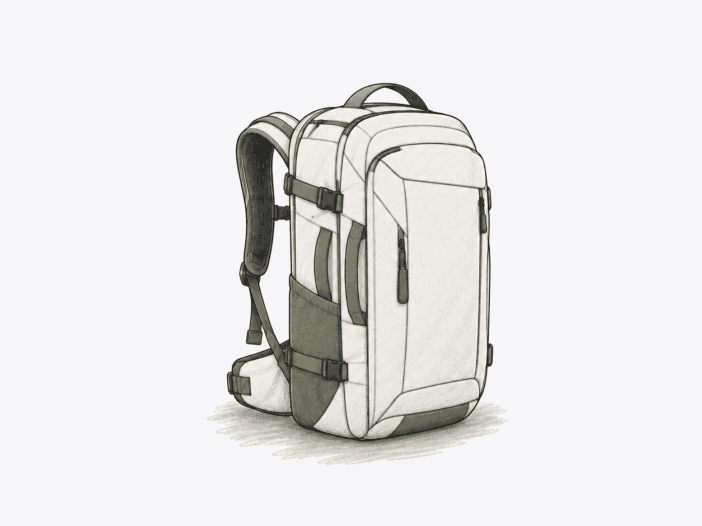
The Pacsafe EXP45 solves a real problem for security-focused travelers: it offers a carry-on with enough space for multi-day trips and built-in anti-theft hardware. If you want that security and can accept a few extra steps to get inside, this pack fits those needs. The main trade-off is slower access, but for some buyers, that delay feels like peace of mind instead of a hassle.
This security-access trade-off shows up in almost every buyer report.
Buyers who like the locking system point to the extra steps as a real security benefit. Some of those same buyers call the system fiddly or tricky, saying it takes time to learn. One buyer disagreed, saying the anti-theft features did not feel cumbersome in daily use.
The real decision is not whether the EXP45 has security features—the evidence is clear on that point. The practical question is whether slower, more deliberate access feels like peace of mind or just a hassle in your own travel routine.

At a Glance
- Best-supported use: multi-day air travel with clothing, documents, and tech carried as a backpack.
- Recurring strength: buyers repeatedly describe the main storage as roomy and the security hardware as valuable.
- Main trade-off: the locking complexity that delivers security also slows you down when you need to get inside quickly.
- Key fit boundaries: under-seat placement, clearance for larger laptops, front-pocket access, and comfort if you plan long walks.
- Evidence limit: the buyer feedback does not prove universal airline compliance, theft-proof performance, exact laptop-size limits, or a product-wide durability rate. Treat these as boundaries, not guarantees for your own setup.
Product Snapshot
| Product detail | What the evidence supports |
| Carry role | Buyer feedback is concentrated on carry-on travel, airports, international trips, and extended travel rather than light everyday use. |
| Packing pattern | Several buyers report substantial travel capacity. One specifically describes a suitcase-style main compartment holding about a week of tightly rolled clothing. |
| Security pattern | Multiple buyers value the locking zippers and related security hardware. Several also report a learning curve or fiddly operation. |
| Tech carry | Laptop/tablet use appears repeatedly, but larger-laptop fit is mixed in the evidence. |
| Evidence boundary | Version history is incomplete, and observed airline, durability, and security outcomes remain buyer-reported rather than universally verified. |
Buyer Evidence Metrics
| Buyer Question | Metric | Evidence |
| Does security value tend to appear with owner-side access friction? | TCR 0.80 | Limited · n=5 |
| Does the evidence separate carry-on/overhead use from stricter under-seat use? | UBC 1.00 | Limited · n=5 |
| Does security-oriented construction also appear with added weight? | TCR — | Very Limited · n=2 |
Trade-Off Coupling Rate (TCR) measures how often an observed strength co-occurs with a specific friction in eligible buyer evidence. Use Boundary Consistency (UBC) to measure how consistently eligible buyer evidence separates a supported use case from the condition under which that use becomes more limited. n is the number of relevant, eligible, deduplicated buyer observations used for the metric, not the product’s total review count. These are buyer-evidence signals, not product-performance scores. See how these buyer-evidence metrics work.
The TCR of 0.80 is based on five eligible buyer observations about security and owner-side access. Four paired the security benefit with fiddly, tricky, or learnable access friction. One buyer directly contradicted a universal-friction interpretation by saying the anti-theft features were not cumbersome.
The UBC of 1.00 is also based on five eligible observations. In this limited set, buyers repeatedly reported successful carry-on or overhead use, while the separate under-seat example protruded by a couple of inches. That supports a narrow use boundary; it does not prove the bag will meet every airline’s size rules.
Only two eligible observations support the weight relationship, so the public numeric TCR is intentionally suppressed.
Fit–Friction Matrix
| Buyer Setup / Context | Fit Signal | Main Friction |
| Multi-day clothing plus mixed carry-on essentials, with overhead stowage as the target | Recurring Strong Fit | One under-seat example protruded by a couple of inches, so strict under-seat fit remains conditional. |
| Security-first international travel where theft deterrence matters more than instant access | Generally Works | Several buyers report that the locking sequence takes practice or feels fiddly. |
| Laptop/tablet travel, especially with a larger computer | Conditional Fit | One buyer fit a 16-inch Logitech gaming computer, while another reported that the outside laptop pocket was tight for larger laptops. |
| Long airport walks or extended loaded carry | Generally Works | Comfort is positive in several reports, but one buyer experienced shoulder-strap pinching on long airport walks. |
| Camera gear box plus other carry-on necessities | Specific Example Only | One direct setup supports this use; camera-cube compatibility evidence partly involves an earlier EXP45L version. |
| Convention A/V kit with a small computer, power supply, cables, adapters, and hand tools | Specific Example Only | One detailed setup supports the use, but repeated evidence is not available. |
Where the EXP45 Fits Best
The strongest evidence does not just support ‘travel’ in general. It points to carry-on trips where you pack enough gear that both space and security become real concerns. If you travel light or never worry about theft, the EXP45’s main strengths may matter less.
Several concrete examples support that:
- A buyer traveling to Germany reported fitting about a week’s worth of tightly rolled clothing and successfully using the bag as a carry-on.
- A buyer on a 10-day trip to Greece reported packing everything they needed, carrying the bag comfortably, and having no airline carry-on issues.
- A buyer traveling in Europe reported comfortable airport carry and successful overhead stowage.
- A buyer used the bag for roughly 25 lb of gear during two weeks of train travel and Grand Canyon touring and described it as comfortable in that specific setup.
These are individual travel outcomes, not universal guarantees. Still, the pattern suggests the EXP45 works best as a roomy carry-on for multi-day trips where both space and security matter for your setup.
Security Is the Main Strength and the Main Compromise
Several buyers describe the security system as a reason they chose or liked the EXP45.
One buyer described a multi-step opening process involving a buckle, a lock, zipper-retention hardware, linked zipper pulls, and then the zipper. Other buyers said the hardware took some getting used to or felt intentionally fiddly.
That evidence supports a clear relationship:
The bag’s security value comes from making access less immediate. This access delay is the point, not a side effect.
For a traveler worried about opportunistic access at airports, on public transport, or in crowded destinations, that extra friction may feel worthwhile.
For a traveler who repeatedly reaches for documents, electronics, or small items, the same friction may become irritating.
One buyer on a trip to Greece said the anti-theft features were not cumbersome. That feedback shows not everyone experiences the same compromise.
Carry-On Evidence Is Stronger Than Under-Seat Evidence
Several buyer reports describe successful use of carry-on or overhead stowage.
Examples include Germany, Greece, Europe, and repeated-flight use. One buyer specifically said the bag fit well in overhead compartments on planes and trains.
The under-seat fit evidence is much narrower. Only one buyer described trying it, and the bag stuck out by a couple of inches.
One buyer placed the bag under the front seat and said it stuck out by a couple of inches. This fit detail makes strict under-seat use more conditional than overhead carry in the available evidence.
The evidence does not include a verified set of official dimensions or airline-by-airline fit testing, so buyers should not treat these reports as evidence of universal airline compliance.
Laptop Fit Is Mixed
The overall travel capacity sounds reassuring, but the evidence for laptop fit is less clear. A large bag does not guarantee your large laptop will fit.
The feedback contains both of these observations:
- One buyer reported fitting a 16-inch Logitech gaming computer;
- Another buyer said the outside laptop pocket did not expand much and became tight for larger laptops.
Other buyers carried laptops or tablets without reporting fit problems.
Those observations don’t provide enough detail to set a reliable maximum device size. The evidence is missing exact laptop dimensions, thickness, sleeve use, and pocket measurements. If your laptop is close to 16 inches or thick with a case, measure your setup before you buy.
If your laptop is large or thick, check the actual computer-plus-sleeve dimensions against the pocket. Do not assume the bag’s overall capacity means your laptop will fit.
Organization Is Useful, but Front-Pocket Access Is More Conditional
Organization feedback trends positive.
One buyer said the compartments made items easier to find. Another carried documents, a laptop or tablet, and travel essentials in separate areas. A convention A/V user described organizing a small computer, power supply, coupler, pens, tweaker, cables, C-wrench, screwdrivers, and adapters.
But the front area draws more conditional feedback.
- One buyer wanted more compartments in the front pocket.
- Another wished the front pockets were easier to access.
The available evidence supports good overall organization, but fast or highly segmented front-pocket access is less consistent. If you need to grab small items quickly, expect the front pocket to slow you down.
What Buyers Carry With It
The evidence includes several useful examples of loads beyond clothing.
Camera carry
One buyer reported fitting a travel camera gear box while still having space for other carry-on necessities.
A different reviewer said an earlier EXP45L Version 1 worked with Peak Design V1 Camera Cubes and stated that the newer Version 2 remained compatible with the same cube dimensions. Because that comparison crosses versions and comes from one reviewer, treat it as a specific compatibility report rather than a universal specification.
Convention A/V carry
One buyer described carrying:
- an iPad or small Yoga computer;
- power supply and coupler;
- pens and a tweaker;
- several cables;
- a C-wrench and screwdrivers;
- adapters stored in internal zipper pockets.
That setup works for compact technical gear, but it’s based on one buyer’s specific configuration. Treat this as a single example, not a guarantee for all A/V loads.
Comfort Is Mostly Positive, but Long-Walk Friction Exists
Comfort feedback trends positive in the evidence.
Buyers describe comfortable airport carry, comfortable backpack use, supportive straps, and one specific two-week example with roughly 25 lb of gear.
Still, one buyer reported the shoulder strap pinched during long walks through the airport. If you expect to walk long distances with a loaded pack, test the straps under real weight before committing.
That single report does not prove a broad comfort problem. It does show that positive comfort feedback should not be treated as universal, especially if you expect long terminal walks with a loaded pack. Test comfort under your own load before deciding.
Weight Is a Real but Lightly Supported Trade-Off
Two eligible buyer observations connect the security-oriented construction with added weight.
One buyer described the bag as “a bit heavy” and attributed that to the anti-theft materials. Another said the security features added some weight but did not consider the amount significant.
With only two eligible observations, the evidence is too thin for a strong generalized claim.
The safer conclusion is narrower. Some buyers cite the weight of the security hardware as a cost, but the evidence doesn’t show how common that concern is. If you are sensitive to pack weight, check the empty weight before you buy.
Durability Feedback Is Positive Overall, but Not Uniform
Many reviews describe the EXP45 as rugged, durable, or well-made. Some buyers report repeated flights, more than six months of travel, or long-term use.
The same evidence set also contains isolated failures:
- one buyer reported a strap-locking mechanism breaking after one trip;
- one buyer returned a unit because of uneven or asymmetric seams;
- Another buyer reported that a top seam near the handle tore during use.
These reports are decision-relevant, but they do not establish a product-wide failure rate.
The evidence supports a cautious conclusion. Quality feedback trends positively, but isolated seam, stitching, and locking-hardware failures still appear in the buyer record. Inspect seams and hardware early if durability matters for your setup.
Version Comparisons Need Restraint
One reviewer explicitly compared the newer EXP45 Version 2 with an earlier EXP45L Version 1.
That reviewer described Version 2 as having:
- sturdier zippers;
- tougher nylon;
- continued compatibility with the same Peak Design camera-cube dimensions;
- a tight zipper-slider latch that became easier to use with repetition.
The same reviewer also compared the sturdiness of the Version 2 zipper favorably against that of a Peak Design 45L camera backpack.
These observations should remain attached to that review. The broader evidence does not identify product versions consistently enough to build a complete Version 1-versus-Version 2 specification.
What Buyers Should Check Before Buying
The EXP45 makes the most sense when its compromises match your actual priorities. If you value security enough to accept slower access and a few extra steps, this pack fits your needs.
- Check your tolerance for deliberate access. Several security-positive buyers also describe the locking system as fiddly, tricky, or time-consuming to learn.
- Measure your laptop setup. A 16-inch Logitech gaming computer fit in one report, while another buyer found the exterior pocket tight for larger laptops.
- Separate overhead carry from under-seat carry. Successful carry-on and overhead reports are more common; the under-seat example stood out.
- Weigh walking distance, not just packing capacity. Comfort feedback is positive overall, but one long-airport-walk report describes shoulder pinching.
- Inspect seams and locking hardware early. Isolated reports include uneven stitching, a torn top seam, and a failed strap-lock mechanism.
- Verify the seller if warranty support matters. One buyer reported that a strap-lock failure was not covered because the purchase came through a seller the buyer later learned was unauthorized. The evidence does not establish the brand’s full warranty policy.
Bottom Line
Buyer feedback points to the Pacsafe EXP45 as a security-first, roomy carry-on backpack with deliberate access.
The strongest evidence comes from multi-day travel, airport use, overhead carry, and security-conscious packing. The main limitation ties directly to that strength: the locks and security hardware can make access slower or more fiddly.
The remaining boundaries depend on your setup. Larger-laptop fit is mixed. Strict under-seat use is less supported than overhead carry. Comfort is mostly positive but not universal on long walks. Quality feedback trends positive, but isolated seam, stitching, and locking-hardware failures keep durability claims in check. Check your gear and travel pattern against these limits before deciding.
For buyers who value security enough to accept those conditions, the EXP45 aligns well with the use cases described in the evidence.
