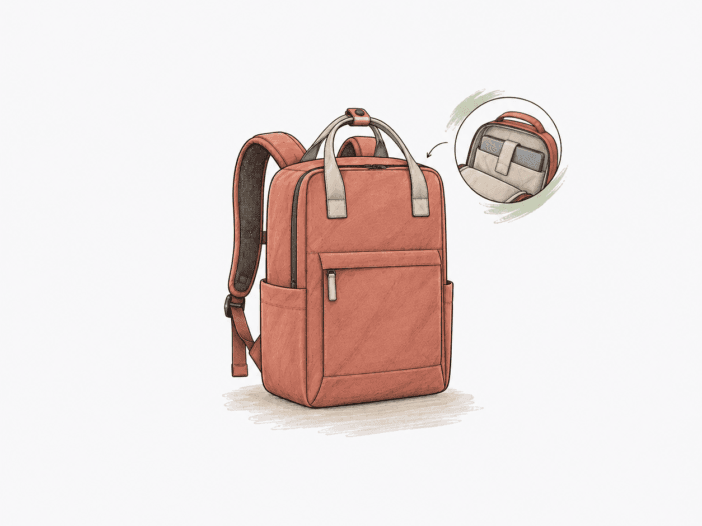
The Kånken Laptop 15-inch works for buyers who keep things simple: a thinner laptop, a few books or notebooks, and a compact set of daily essentials. Most positive feedback comes from people who want a small-profile backpack with a dedicated laptop sleeve and a main compartment that opens wide for easy access.
That compact shape brings a real trade-off. Buyer reports turn mixed when laptops get thicker or push the upper end of the 15 to 15.6-inch range. Wide bottles usually fight the side pockets. Bulky extras like lunch quickly eat up the rest of the main compartment.
The real question is not just, ‘Is my laptop 15 inches?’ What matters is whether your laptop size, bottle width, daily load, and shoulder fit leave enough breathing room in this bag.

Product Snapshot
A few details drive most decisions here:
- Most useful buyer evidence comes from the 15-inch laptop version. These conclusions stick to this size, not the whole Kånken Laptop family.
- The 18L capacity comes from three Q&A answers. Buyers and sellers report that number, but the manufacturer doesn’t confirm it in the specs.
- The laptop has its own compartment. Buyers like that separation, but fit still changes a lot between different 15- to 15.6-inch laptops.
- The main compartment opens wide and keeps things simple. This layout works for buyers who want open space instead of built-in organizers.
- The front pocket and two side pockets give you basic separation, not heavy organization. Buyers often call the front pocket small or awkward. The side pockets run tight for wide bottles.
- Padded shoulder straps work for many buyers, but not everyone. Most comfort reports are positive. Some buyers mention support issues, seam pressure, or friction with body fit.
- Buyer evidence supports moisture resistance, not full waterproofing. Spills and light rain usually end fine. Heavier or longer rain has let water in.
- Q&A confirms the laptop compartment sits right at the bottom of the bag. There is no raised false bottom for extra impact clearance.
Buyer Evidence Metrics
| Buyer Question | Metric | Evidence |
| How consistently does laptop fit change between smaller/thinner devices and larger or thicker 15–15.6-inch devices? | UBC 0.79 | Moderate · n=19 |
| How clearly do the side pockets separate slim/smaller bottles from large or wide bottles? | UBC 1.00 | Limited · n=6 |
| How consistently does moisture resistance change from spills/ordinary rain to sustained or heavier rain? | UBC 0.86 | Limited · n=7 |
| Is shoulder/body-fit friction more concentrated among broad-shouldered users? | CFL — | Very Limited · n=2 |
How these metrics work: Use Boundary Consistency (UBC) measures how consistently eligible buyer evidence separates a supported use case from the condition where that use becomes more limited or conditional. Context Friction Lift (CFL) measures whether a known friction is more concentrated in a defined eligible context than in the eligible baseline; for CFL, public n reflects the smaller eligible comparison group. n is the number of relevant, eligible, deduplicated buyer observations used for that metric—not the product’s total review count. These are buyer-evidence signals, not product-performance scores. See how these buyer-evidence metrics work.
What those signals mean in practical terms:
- Laptop fit hits a real boundary, but there is no hard cutoff at screen size. UBC 0.79 does not mean a 79% chance your laptop fits. The evidence usually separates easier fits for smaller or thinner laptops from tight or failed fits with bigger or thicker 15- to 15.6-inch models. Some larger laptops still fit, so screen diagonal alone will not predict the outcome.
- Bottle-pocket fit shows a sharper size boundary, but it’s based on a small sample. UBC 1.00 comes from just six eligible reports. In those, slim or small bottles fit. Large or wide bottles are usually tight or do not fit at all.
- Weather protection depends on exposure. UBC 0.86 comes from seven eligible reports. Spills and light rain usually end well. Heavier or longer rain is where the evidence falls short.
- Broad-shoulder fit is a warning, not a settled fact. Only two eligible reports back up that context. There is no public CFL number.
Fit–Friction Matrix
| Buyer Setup / Context | Fit Signal | Main Friction |
| Smaller/thinner laptop, including 13-inch-class devices, plus books, notebooks, or compact work essentials | Recurring Strong Fit | No recurring laptop-fit friction is established in these smaller-device examples; bulky extras can still reduce remaining main-compartment space. |
| Larger or thicker 15–15.6-inch laptop, especially where chassis dimensions or a sleeve add bulk | Mixed / Variant-Dependent | Several buyers report very tight closure or outright non-fit, while other 15-inch and one reported 16-inch MacBook setup succeed. |
| Laptop plus a compact school/work load in the main compartment | Generally Works | Lunch or other bulky additions can become the item that no longer fits once the core load is already packed. |
| Slim bottle, smaller cup, or narrow side-pocket item | Generally Works | Wide reusable bottles and 32 oz bottles are repeatedly reported as tight or non-fitting. |
| Long or loaded carry for users whose shoulder fit works with the strap geometry | Mixed / Variant-Dependent | Many buyers report comfortable loaded carry, but others report insufficient support, seam pressure, or poor fit; broad shoulders are a specific caution. |
| Spills or ordinary rain exposure | Conditional Fit | Several buyers report successful resistance, but sustained/heavier rain has produced ingress and the supplied evidence does not support waterproofing. |
Variant Fit Patterns
Laptop compatibility is where the product name can trip up buyers who take it at face value.
The more forgiving side of the evidence:
- 13-inch-class and thinner laptops repeatedly fit with usable margin.
- One example fits a 13-inch MacBook Pro while it is still inside a Logic hard-shell sleeve.
- Several buyers successfully carry 15-inch laptops, including one older, bulkier MacBook Pro.
- One supplied buyer report says a 16-inch MacBook Pro fits.
The tougher side of the evidence:
- Several 15-inch and 15.6-inch laptops are described as very snug, too tall, or unable to close in the dedicated laptop compartment.
- A protective sleeve can further reduce usable fit margin when the laptop is already near the compartment boundary.
- Since both successful and failed 15-inch-class fits show up, the evidence does not support a rule that every 15-inch laptop fits or every 15.6-inch laptop fails.
The real boundary is not screen size. Chassis height, width, thickness, and whether you use a sleeve matter more. When buyers hit that fit wall, the 17-inch Kånken Laptop becomes the next step. The evidence supports switching sizes, but there is not enough clean data to judge the 17-inch version overall.
How Buyers Use It
The evidence clusters around a few recurring setups rather than one universal use case:
- School and campus carry: laptop plus textbooks, notebooks, binders, planners, folders, or a pencil case recur frequently.
- Work commuting: buyers describe simpler laptop-and-essentials loads, including planners and pen cases; one commuter reports that adding lunch no longer fits comfortably once the core load is packed.
- Everyday carry: buyers use the simple main compartment for mixed daily items without relying on many internal organizers.
- Travel: examples include a London trip, international travel, sightseeing, day trips, and a 20-hour flight. These are individual buyer examples, not evidence of airline-specific compliance.
Across all these uses, the same pattern shows up. The bag feels roomier than it looks, but only if you stick to flat or moderate items. Add lunch, a wide bottle, or other bulky extras and space runs out fast.
What Buyers Carry With It
Recurring examples help define the bag’s practical load profile:
- 13-inch MacBook Pro or MacBook Air + books/notebooks: this is one of the more consistently supported combinations. One 13-inch MacBook Pro is explicitly reported to fit inside a Logic hard-shell sleeve.
- Textbooks, notebooks, binders, planners, folders, and pen/pencil cases: these recur across school and work setups and explain why some buyers describe the bag as more spacious than it first appears.
- 16 oz Contigo cup or 24 oz Owala bottle: both are reported to fit the side pockets in one commuter setup, although the Owala requires some effort.
- Lunch or a lunch box: evidence is mixed. Some fuller loads accommodate it, while one compact commuter setup runs out of room once you add lunch.
That difference matters. The real capacity problem is not one flat item. It is when several bulky things all fight for the same small space.
Organization: Simple by Design, Limited by the Same Choice
Organization is consistent here: the same design choice gives you both the main strength and the main weakness.
Why some buyers like it:
- The main compartment opens wide, which makes packing and unpacking straightforward.
- The laptop has its own rear compartment instead of sharing the main space.
- Buyers who use pouches or prefer one open cavity don’t have to work around many fixed dividers.
Why some buyers do not:
- The front pocket is repeatedly described as small, tight, or awkward to access, especially when the main compartment is full.
- Some buyers report stiff or inconvenient zipper handling.
- Buyers who want many dedicated small-item pockets may find the layout too sparse.
Open packing flexibility is a real strength only if you actually want open packing. The evidence does not show that minimal organization is always better.
Comfort Comes Down to Body Fit, Not Just Padding
Most comfort reports are positive, but the evidence is not strong enough to promise comfort for everyone.
Positive examples include petite users, students carrying heavy books, teachers, work users, and travelers carrying the bag for extended periods. Several buyers describe the load as feeling lighter or easier to carry than expected.
Still, the mixed reports matter for your decision:
- Some buyers report that the straps do not provide enough support.
- One buyer reports seam pressure at the upper back/shoulder area.
- Broad-shouldered buyers provide a small but repeated warning that the available strap geometry can feel restrictive.
- One comparison notes more strap padding than a traditional Kånken but less support than an older Dakine backpack.
With only two eligible reports on broad-shoulder fit, the evidence is too thin for a public CFL number. If you have broad shoulders or want high-support carry, check the fit in person.
Weather Protection: Useful Resistance, Not Waterproofing
Buyer evidence only supports a narrower claim than waterproof.
Several buyers report positive outcomes from coffee spills, ordinary rain, or water being repelled. Those examples support some moisture resistance under lighter exposure.
At least one buyer reports contents getting wet in rain, and the Q&A warns the material is not meant for heavy rain or water sports. The evidence supports a clear boundary: spills and light rain are usually fine, but don’t count on protection in heavy or prolonged rain.
What Buyers Compare It With
The evidence brings up a few alternatives for specific reasons:
- 17-inch Kånken Laptop: considered when a 15–15.6-inch laptop is too tight for the focal 15-inch model. The evidence supports this size-switching logic, not a full evaluation of the 17-inch version.
- Kånken Classic / 13-inch size: compared for space, laptop separation, and the laptop model’s padded straps. The buyer comments establish the comparison context but do not establish an overall winner.
- Jansport and Dakine backpacks: individual buyers use these as reference points for comfort, support, or durability. These are anecdotal comparisons, not controlled comparative testing.
What Buyers Should Check Before Buying
- Check if your bottle is actually slim enough for the side pocket. The evidence is limited but consistent: smaller bottles fit, but wide reusable bottles and 32 oz bottles often don’t.
- Think through your real daily load before judging the 18L size. The 18L number comes from three Q&A answers. Buyer evidence shows that a laptop plus flat essentials and a laptop plus bulky extras use up space very differently.
- Decide if you want open packing or built-in organization. The wide-opening main compartment is handy, but the front pocket and low compartment count frustrate buyers who want more separation or faster access.
- Treat shoulder comfort as a fit check, not a guarantee. Many buyers report comfortable carry, but support complaints and limited broad-shoulder evidence mean body fit still matters.
- Do not count on the bag for waterproof protection. The evidence supports some spill and light rain resistance, but heavier exposure has let water in.
- Do not rely on the bag as waterproof protection. The evidence supports some spill and ordinary-rain resistance, but heavier exposure has caused water ingress.
The Kånken Laptop 15-inch works best if you treat its compact size as a real boundary, not a promise of unlimited flexibility. Buyer evidence is strongest for a thinner laptop, a straightforward school or work load, slim bottles, and a preference for simple open storage. As your laptop gets thicker, your bottle gets wider, your load gets bulkier, or your shoulder-fit needs increase, the same compact design becomes less practical.
Want to see how this 18L setup compares with other compact options? Explore our Best Small Laptop Backpacks.
