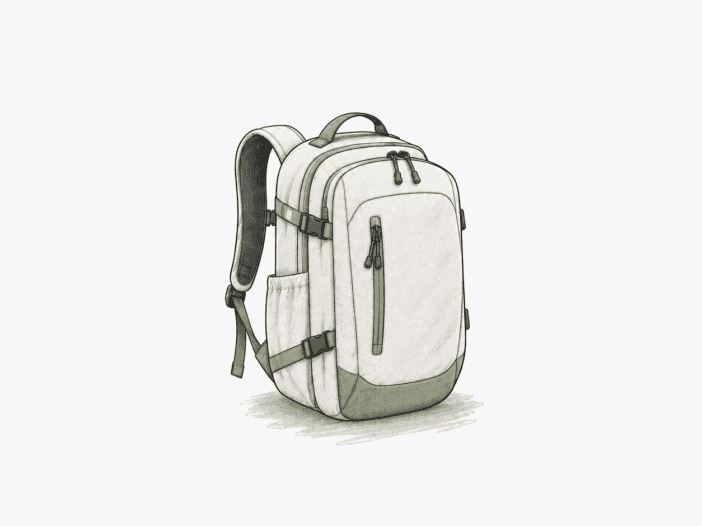
The real split is not between 26L and 32L buyers. It comes down to how you pack.
Open packing works for buyers who want flexibility. If you need built-in structure, this bag feels less satisfying.
Buyers who like the Osprey Daylite Expandable Travel Pack usually want a light clamshell bag for clothes, toiletries, a laptop or tablet, and a few travel accessories. Packing cubes or pouches fill the structural gap.
The design runs into limits if you need lots of built-in tech pockets, stronger laptop padding, a wide bottle pocket, or a bag that always passes as a personal item on every airline.
Expanding to 32L gives you more space for short trips or heavier workloads. Buyer reports show less clearance in tight transit spaces and with stricter personal-item rules.

At a Glance
- Strongest fit pattern: simple clothing-first or packing-cube travel loads that benefit from a large clamshell opening.
- Main configuration choice: stick with 26L if you care about compact size. Expand to 32L only when you actually need more space.
- Main organization boundary: buyers who want lots of fixed tech or admin pockets hit more friction than those who use cubes or pouches.
- Main airline caution: buyer reports on underseat fit are mixed, and most do not say if the bag was expanded. Underseat fit depends on airline, seat, how full you pack, and whether you expand the bag.
- Main protection caution: buyers carry 15- and 16-inch laptops, but the evidence does not support strong impact or bottom protection for those setups.
Product Snapshot
| Product detail | Decision relevance |
| 26L base configuration with 6L expansion to 32L | This is the repeatedly supported capacity framing in the supplied evidence. Expansion increases usable room, but it also reduces compactness. |
| Clamshell / suitcase-style main opening | Repeated buyer feedback supports easy clothing-first packing, visibility, and packing-cube use. |
| Separate laptop / tablet access | Buyers report carrying tablets and 15- to 16-inch laptops. Fit is reported; strong protective performance is not established. |
| Two exterior bottle pockets | Size-specific evidence favors medium or slimmer bottles. Wider bottles become more conditional, especially when the bag is packed out. |
| Sternum strap and luggage-handle pass-through | Useful airport-oriented features are repeatedly reported, but shoulder and back comfort remain mixed across buyers. |
Buyer Evidence Metrics
| Buyer Question | Metric | Evidence |
| Does simple open packing hold up better than pocket-intensive tech/admin use? | UBC 0.82 | Moderate · n=17 |
| Does the low-weight strength commonly appear with strap or back discomfort? | TCR 0.27 | Moderate · n=15 |
| Does a full main compartment increase quick-access-pocket friction? | CFL 1.50× | Limited · n=4 |
| Is there a consistent bottle-width boundary? | UBC 1.00 | Limited · n=4 |
How these metrics work: Use Boundary Consistency (UBC) measures how consistently eligible buyer evidence separates a supported use case from the condition where that use becomes more limited or conditional. Trade-Off Coupling Rate (TCR) measures how often an observed product strength co-occurs with a specific friction in eligible buyer evidence. Context Friction Lift (CFL) compares how concentrated a known friction is in a defined context with its eligible baseline; for CFL, public n reflects the smaller eligible comparison group. n is the number of relevant, eligible, deduplicated buyer observations used for that metric—not the product’s total review count. These are buyer-evidence signals, not product-performance scores. See how these buyer-evidence metrics work.
What the metrics actually change
UBC 0.82 does not mean you have an 82% chance this bag will work for your setup. It means buyer evidence is pretty consistent on one line: simple, open packing setups fit better than loads that need lots of built-in tech or admin pockets. That line is not absolute. Some tech-heavy setups still worked, but not as often.
TCR 0.27 does not mean low weight causes discomfort. Only a few buyers who liked the low weight also mentioned strap or back friction. Most buyers who praised the low weight found the carry comfortable for their setup.
CFL 1.50× indicates that pocket friction occurs more often when the main compartment is packed full, but the evidence is limited (n=4). One buyer with a packed bag still found the front pockets worked well. Treat this as a context warning for packed loads, not a universal rule.
UBC 1.00 for bottle width also comes from Limited evidence at n=4. All four size-specific reports say medium or slim bottles fit cleanly. Larger or wider bottles become more conditional in these setups. Four reports do not establish universal fit.
Fit–Friction Matrix
| Buyer Setup / Context | Fit Signal | Main Friction |
| 26L unexpanded + clothing-first or packing-cube personal-item load | Conditional Fit | Direct 26L evidence supports useful compact capacity, but airline fit is not guaranteed and becomes more sensitive as the bag is filled. |
| 32L expanded + overnight or short work-trip load | Generally Works | Extra capacity is useful, but expanded bulk reduces tight-space convenience and personal-item margin. |
| Clothing, toiletries, and travel essentials organized in the open clamshell space | Recurring Strong Fit | Buyers who need more built-in segmentation may need packing cubes or separate pouches. |
| Laptop or tablet + clothing + ordinary travel electronics | Generally Works | Separate access helps, but laptop padding and bottom protection receive mixed buyer assessments. |
| Tech/admin-heavy carry with many small accessories or rigid organization needs | Conditional Fit | Limited independent pocket volume and relatively simple internal organization can become the bottleneck. |
| Medium or slender bottle + ordinary travel load | Generally Works | Wider bottles become less reliable, especially when the main compartment is heavily filled. |
Variant Fit Patterns
26L unexpanded: choose compactness first
Direct 26L evidence is limited, so only narrow conclusions hold up.
What it supports:
- Multiple directly scoped contributions describe useful capacity in the unexpanded state.
- One buyer reported fitting a full week’s clothing without opening the expansion.
- The 26L state works best for buyers who want a compact bag and open packing space. If you need maximum capacity or lots of built-in pockets, look elsewhere.
What it does not establish:
- It does not establish universal personal-item compliance.
- It does not establish that a fully packed 26L load will fit every airline sizer or under every seat.
- Most airline observations in the evidence do not identify the expansion state, so you can’t reassign them to the 26L configuration without guessing.
Buyer decision: start with 26L if you want to keep the bag compact. Do not just default to 26L when you have less to pack.
32L expanded: choose capacity first
Direct evidence for the expanded state is also limited, but the use cases are clear.
Reported examples include:
- Two outfits + electronics + toiletries: one buyer used the expanded bag for an overnight-style load and later found it bulky on crowded trains in Japan. That is one specific tight-transit example, not a general statement about Japan or public transit.
- Heavy 15-inch work laptop + clothes + toiletries: one buyer reported this setup working for a three-day work trip with the expansion open.
- Laptop + large lunchbox + 1.5 L water bottle + umbrella + crossbody + foldable keyboard + mouse + shaker bottle: one buyer reported fitting this larger mixed load in the expanded state with some room remaining.
The pattern is clear: 32L gives you more space, but you lose some of the compactness that makes 26L appealing.
One Q&A report warned that expanding the bag can hurt fit for personal items. Since that is just one airline example, treat it as a caution for tight airline rules, not a rule.
How Buyers Use It
Air travel
Buyers often use the bag as a personal item or underseat bag. Results are mixed.
One buyer reported good underseat fit on American Airlines and a much tighter fit on United. Other individual buyers reported successful use on airlines including SAS and Ryanair. Separate contributions reported sizer sensitivity, incomplete underseat fit, or the need to avoid overfilling.
Most airline reports don’t say whether the bag was expanded. Airline fit varies by carrier, seat, and how full you pack, so you cannot count on universal personal-item approval.
Short trips and one-bag travel
The open clamshell layout works well for clothes and toiletries, especially if you use packing cubes or like a simple, suitcase-style interior.
Buyers use the bag for overnight, weekend, and multi-day trips. The evidence supports usable travel capacity, but there is no universal number of days since packing style changes the outcome.
Work travel
Work-travel reports are positive when buyers need to carry a laptop, clothes, and regular travel gear together.
Still, the evidence shows a limit. Buyers who want lots of admin pockets or stronger laptop protection may find the layout too simple for their needs.
Destination day use
Some buyers unpack at their destination and use the bag as a daypack.
One buyer in Japan used the bag for both overnight and day trips. Another buyer in India used it as a backup daypack for family travel. These examples show flexibility, but do not mean the bag will replace a purpose-built daypack for every setup.
What Buyers Carry With It
The most useful evidence comes from real-world packing setups.
- Large mixed tech-and-clothing load: one buyer packed a 16-inch laptop, iPad Pro, Kindle, full-size keyboard, Nintendo Switch, clothes, a water bottle, pouches, and snacks. Carry comfort was good for that setup, but the buyer still criticized bottle-pocket stretch and some admin layout choices.
- Three-day workload: one buyer carried a heavy 15-inch work laptop, clothes, and toiletries with the expansion open. This supports that setup, but doesn’t show universal laptop protection for all buyers.
- Camera and electronics load: one buyer used the bag for camera gear, electronics, and travel essentials, and liked the full opening and separate laptop area for access. This example shows how the bag works for camera gear, but it does not prove that it protects cameras in every setup.
These examples show a clear pattern. Capacity usually meets the need before organization or protection becomes the main limit.
What Buyers Compare It With
Buyer comparisons are personal, not lab tests. Still, they help show what trade-offs buyers actually notice.
- Aer Travel Pack 3: one buyer preferred the Osprey because it felt much lighter while carrying a similar perceived amount of clothing and gear.
- Aer Travel Pack 2 / City Pack 2: another buyer considered the Aer materials and admin organization more premium, while viewing the Osprey as lighter and less expensive.
- Bellroy Travel Bag 30L: one buyer reported fitting more into the Osprey despite the Bellroy’s nominally larger capacity class.
- Patagonia Refugio 30L, Mini MLC 30L, and Black Hole 25L: one buyer compared these directly and preferred the Osprey for personal-item use and expansion.
- Fjällräven Kånken No. 2 15-inch: one buyer found the Osprey lighter when empty and more useful for personal-item capacity.
The pattern matters more than any single preference. Buyers see the Osprey as light and roomy. More structured bags work better for anyone who wants a more organized look or a more premium feel.
What Buyers Should Check Before Buying
- Check your airline and how you pack. The evidence does not guarantee underseat or personal-item fit. Carrier rules, seat shape, how full you pack, and whether you expand the bag all shift the outcome.
- Decide if you organize with built-in pockets or your own pouches. Evidence is strongest for buyers who like the open clamshell layout. Buyers who want lots of fixed tech or admin pockets hit more friction.
- Separate laptop fit from laptop protection. Buyers carry 15- and 16-inch laptops, but several reports question bottom or sleeve protection for those setups. Just because your laptop fits does not mean it is protected from impact.
- Check your bottle width, not just the volume. The limited evidence favors medium or slim bottles. Wider bottles become more conditional, especially in a full bag.
- Pay attention to how the bag fits your shoulders and back if you carry it for long periods. Many buyers report comfortable carry, even when the bag is loaded. Recurring complaints include strap padding, strap placement, shoulder slippage, and back-panel discomfort.
- Expand the bag only when you need the extra space. Evidence supports using a 32L bag for longer trips or heavier workloads, but also shows that it loses compactness in tight spaces and under stricter personal-item rules.
The Osprey Daylite Expandable Travel Pack works best as a light, open-packing travel bag with a real capacity switch. Buyer evidence is strongest when the open layout matches your packing style. Fit becomes more conditional if you need the bag to act like a tech organizer, a padded laptop carrier, or a bag that always fits under every seat.

