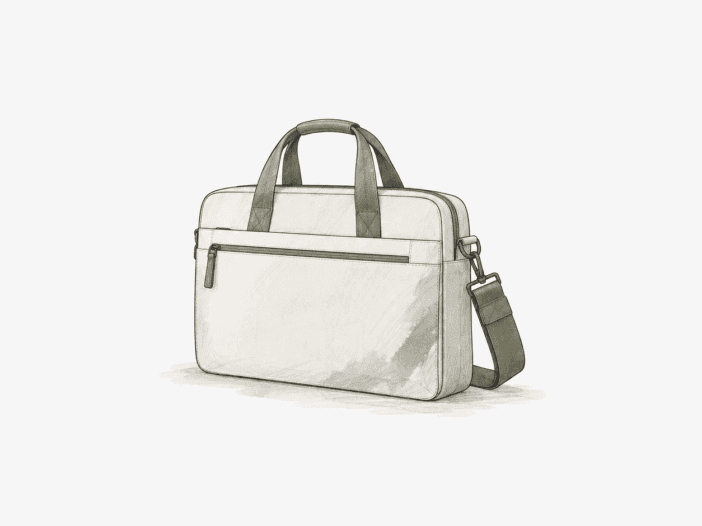
Buyers who carry one laptop, daily work accessories, a few documents, and a bottle or umbrella will find the Bellroy Tokyo Work Bag fits best as a professional briefcase. The fit becomes more conditional once your load starts looking like a stuffed backpack, or if you carry it by the shoulder often enough for strap angle, pressure, or attachment wear to show up.
Some 16-inch laptops, like the ThinkPad P1 and MacBook Pro 16, fit according to buyer reports. Still, screen size alone doesn’t guarantee fit, and shoulder-strap comfort varies without a clear negative pattern.
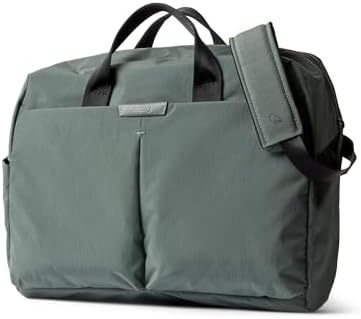
Product Snapshot
The main design works for organized office carry. Once you start packing heavier or bulkier loads, specific details start to shift the buying decision.
| Product detail | Decision relevance |
| Internal dimensions: 17.3 × 14.2 × 6.3 in | Useful as a bag-level size reference, but separate laptop-compartment dimensions are not supplied. |
| Two front compartments zip closed | Buyers value the front access for work and airport-security routines; the zippers are not lockable. |
| Bottle pocket: 18 × 11 cm | Buyer examples include a 32 oz Nalgene and a large umbrella/water bottle, but object shape still matters. |
| “20L” reference appears repeatedly in buyer reports | Practical volume is mixed: many day-work loads fit, while fuller or backpack-equivalent loads can feel tighter than expected. |
| No decision-relevant variant split | Raven/Everglade references are cosmetic in the available evidence and do not change fit logic. |
Buyer Evidence Metrics
Buyer evidence draws a clear line at day-to-day work capacity, shows a recurring trade-off between organization and strap comfort, and sets a device-specific boundary for 16-inch laptop fit.
| Buyer Question | Metric | Evidence |
| Do normal day-work loads separate cleanly from fuller, backpack-equivalent loads? | UBC 1.00 | Moderate · n=17 |
| Does shoulder-strap friction recur even when buyers like the bag’s work organization? | TCR 0.64 | Moderate · n=11 |
| Is 16-inch compatibility better treated as device-specific than universal? | UBC 1.00 | Limited · n=5 |
| Is shoulder-strap friction more concentrated in explicit laptop-plus-additional-item loads? | CFL 1.20× | Limited · n=5 |
How these metrics work:
- Use Boundary Consistency (UBC) measures how consistently eligible buyer evidence separates a supported use case from the condition where that use becomes more limited or conditional. UBC 1.00 is not a 100% probability of fit.
- Trade-Off Coupling Rate (TCR) measures how often an observed product strength appears together with a specific friction among eligible buyer evidence. It does not establish causation.
- Context Friction Lift (CFL) measures whether a known friction is more concentrated in a defined eligible context than in the eligible comparison baseline. It is not a severity or failure-probability measure; public n reflects the smaller eligible comparison group.
- n is the number of relevant, eligible, deduplicated buyer observations used for that metric, not the product’s total review count.
These are buyer-evidence signals, not product-performance scores. See how these buyer-evidence metrics work.
Capacity UBC stands out as the broadest signal. Buyer setups consistently separate workable day-workloads from fuller loads that start to feel tight. Still, four buyers describe the bag as roomy, so that boundary does not hold for every load, especially when the exact setup is unclear.
Strap metrics show a mixed pattern. Strap friction often shows up with positive work-bag features, but several buyers report comfortable shoulder carry instead. The 1.20× CFL only points to a modest increase in friction for laptop-plus-extra-item loads, not a hard failure rule tied to load size.
Fit–Friction Matrix
Load composition and carry method change practical fit more than the 20L label by itself.
| Buyer Setup / Context | Fit Signal | Main Friction |
| Laptop + charger/cables + light documents/notepad + daily small essentials | Recurring Strong Fit | Adding bulkier extras or trying to replicate a fully packed backpack starts to consume usable space quickly. |
| Fuller work load with thick files, paper stacks, sweatshirt, food containers, or other bulky extras | Limited Fit | Several buyers report tighter usable volume than the 20L expectation and pockets that become harder to use when packed. |
| Specific 16-inch laptop + normal work accessories | Conditional Fit | Named 16-inch devices fit, but other 16-inch-class reports describe tight or model/thickness-dependent compatibility. |
| Frequent shoulder carry with a laptop and daily items | Mixed / Variant-Dependent | Feedback conflicts: some buyers find it comfortable, while others report tilt, bouncing, narrow-strap pressure, fraying, stitching expansion, or attachment-area wear. |
| Airport-security routine using the front pockets for phone, wallet, and keys | Specific Example Only | No recurring airport-specific access friction is established beyond the individual example. |
What Buyers Carry With It
Day-work loads fit best. The bag works better as an organized work-day briefcase than as a substitute for a fully packed 20L backpack.
Observed setups show what that means in practice:
- A 16-inch ThinkPad P1, charger, 32 oz Nalgene, wallet, and smaller personal items fit in one documented setup, although that buyer reported the bag falling over rather than standing reliably.
- A MacBook Pro 16 with peripherals and smaller tech items fit in another setup, with positive shoulder-strap comfort.
- A laptop, iPad, cables, accessories, and notepad supported twice-monthly travel over 18 months in one long-term example.
- Another buyer transferred a laptop, wires, paper stacks, miscellaneous items, and a sweatshirt into the bag and described it as roughly 95% full.
Capacity should be read as a load-composition boundary, not a claim that the bag is always small. Some buyers find it roomy. The recurring friction shows up when you start packing thick files, bulky extras, or try to use it like a backpack.
Shoulder Carry Is the Main Trade-Off to Scrutinize
Shoulder carry is where friction recurs most often, but the evidence does not show the strap is always uncomfortable or unreliable.
Recurring complaints include:
- attachment geometry that can make the bag tilt or bounce against the hip or leg;
- a narrow strap or small/sliding shoulder pad that can increase pressure under load;
- fraying, stitching expansion, or wear near the strap attachment points in several reports.
Some buyers call the strap comfortable, including one carrying a MacBook Pro 16. One buyer with a heavy laptop swapped in a wider Optech swivel strap and got much better comfort, but that is a specific fix, not something every buyer will need.
16-Inch Buyers Should Verify the Exact Device
16-inch compatibility only applies to specific devices, not every 16-inch laptop.
Buyers report fitting a ThinkPad P1 and MacBook Pro 16, and another carried a heavy 16-inch laptop. Still, other buyers describe the 16-inch fit as tight or dependent on thickness and shape. One report notes the interior narrows on one side near the bottle pocket.
UBC 1.00 comes from five eligible reports that consistently separate named successful 16-inch fits from broader, more conditional cases. This does not mean every 16-inch laptop will fit.
What Buyers Should Check Before Buying
Match your actual load and carry routine to the recurring boundaries in buyer evidence for the safest decision.
- Check your exact laptop profile, especially if you use a 16-inch device. Since Bellroy doesn’t provide separate laptop-compartment dimensions, buyer reports show that thickness and shape make the difference.
- Pack your full work-day load before assuming the bag will handle 20L like a backpack. Day essentials fit well. Thick files and bulky extras are where capacity complaints show up.
- If you often carry it by the shoulder, treat the strap as a personal fit check. Watch for strap angle, width, pad position, hip or leg contact, and how the attachment area handles your normal load.
- Do not rely on the bag for lockable zipper security. Bellroy Q&A evidence says the zippers are not lockable.
- If you care about the bag standing up on its own, test it with your load. One buyer reports the bag falls over repeatedly, but there is not enough evidence to call this a universal issue.
- Do not treat buyer rain comments as proof of waterproofing. Some buyers report good rain exposure, but the evidence does not show a standardized weather-protection rating.

If organization matters but you are unsure how much capacity you really need, see where the Bellroy Tokyo Work Bag fits among the Best Laptop Briefcases for different work-carry needs.
