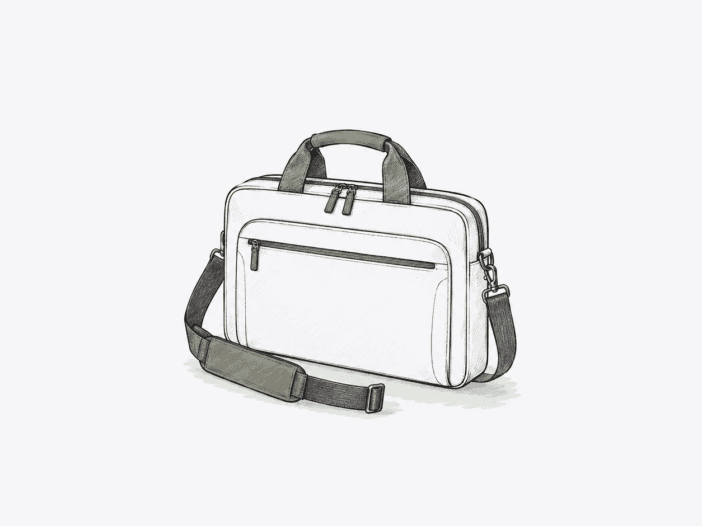
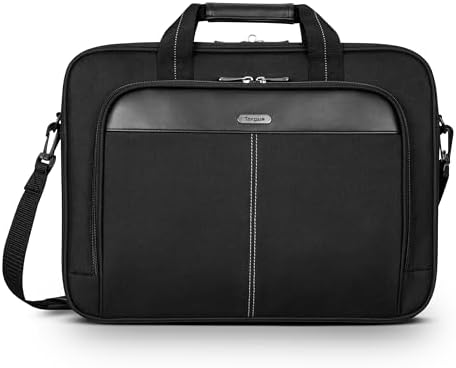
The Targus Classic Slim Briefcase works best for buyers who want a slim, no-nonsense work bag that holds a laptop, charger, mouse, a few documents, and small accessories. The 16-inch buyer evidence supports an essentials-only setup for commuting and business trips. That same slim profile leaves less room for bulky gear or extra internal dividers.
Treating the screen-size label as a fit guarantee leads to the most common buying mistake. Buyer reports cover the full range: some 15.6- and 16-inch laptops fit well, others fit tight, and a few are loose. Results for 17-inch laptops are even more hit-or-miss. If you plan to use the shoulder strap often, check the hardware. Recurring buyer reports mention fixed or plastic clips that can pop off or act up, though those reports do not always specify which bag size they used.

Product Snapshot
Measure the device and think about the load before relying on the “16-inch” label.
| Product detail | Decision relevance |
| Slim, padded, top-loading polyester briefcase | Best suited to lighter essential work carry rather than a highly subdivided clamshell-style setup. |
| Laptop compartment stated by Targus as 15.25 × 10.50 in in one support answer | Physical chassis width, height, and thickness are more useful than screen diagonal alone. |
| Rear slip pocket stated as 12.5 × 10 in | Useful for documents, but the main evidence still favors modest paper loads rather than document-heavy carry. |
| Explicit Size = 16 inch buyer evidence | Supports a laptop-plus-essentials work profile, but many historical fit and strap reports do not identify their exact size variant. |
| Conflicting official water-protection answers | Do not treat the briefcase as having a settled weather-protection claim. |
Buyer Evidence Metrics
Buyer evidence points to a real device-fit boundary and two trade-offs to watch, but these metrics do not measure product performance.
| Buyer Question | Metric | Evidence |
| Does the evidence show a usable laptop-size boundary? | UBC 0.67 | Strong · n=21; exact bag-size variant is not identified in these fit observations, and contradictory fits remain on both sides of the boundary. |
| Does shoulder-carry utility repeatedly appear with attachment friction? | TCR 0.67 | Moderate · n=9; exact size variant is not identified, so this is not a 16-inch-specific failure rate. |
| Does the slim footprint tend to trade against load flexibility? | TCR 0.29 | Limited · n=7; friction is concentrated in bulkier-accessory or document-heavier setups rather than every compact-carry report. |
How these metrics work:
- Use Boundary Consistency (UBC) measures how consistently eligible buyer evidence separates a supported use case from the condition where that use becomes more limited or conditional.
- Trade-Off Coupling Rate (TCR) measures how often an observed product strength appears together with a specific friction among eligible buyer evidence.
- n is the number of relevant, eligible, deduplicated buyer observations used for that metric—not the product’s total review count.
- These are buyer-evidence signals, not product-performance scores, probabilities, rankings, or lab measurements.
See how these buyer-evidence metrics work.
Fit–Friction Matrix
This briefcase handles simple loads well. Fit gets more conditional if you add bulkier devices or extra accessories.
| Buyer Setup / Context | Fit Signal | Main Friction |
| Explicit 16-inch listing + laptop + charger/mouse + light documents for commute or business use | Generally Works | Bulkier accessories reduce flexibility, and the open main area may not provide the separation some buyers want. |
| 15.6–16-inch-class laptop + essentials, exact bag variant not identified | Mixed / Variant-Dependent | Wider or thicker chassis can become tight, while smaller or thinner devices can have excess movement. |
| 17-inch-class laptop, exact bag variant not identified | Conditional Fit | Several reports describe failure or marginal fit, although some 17-inch examples succeed; physical dimensions need verification. |
| Slim daily-work load with modest documents and small accessories | Generally Works | Larger paper loads or extra bulky accessories can push against the slim format. |
| Frequent shoulder carry, exact bag variant not identified | Conditional Fit | Recurring reports describe fixed/non-swiveling or plastic clip attachments releasing, detaching, or becoming awkward under use. |
The 16-Inch Listing Works Best as an Essentials-First Work Case
The 16-inch buyer evidence is strongest when the briefcase carries a laptop or tablet plus standard work accessories. It does not work as well if you expect it to act like a full mobile office organizer.
- Buyers report workable setups with a 16-inch laptop, charger, mouse, folders or documents, pens, and small accessories.
- Commuting, business trips, and professional events carry appear directly in the 16-inch evidence.
- A bulky mouse is one example where the slim profile falls short.
- One 16-inch buyer notes there is no separate internal compartment. If you want clear separation between your laptop and papers, check the layout before buying.
The 16-inch buyer evidence shows the same compactness-versus-capacity trade-off found in the broader buyer record. Only three eligible observations back up that specific metric, so the numeric rate is not published here.
Laptop Fit Depends More on Chassis Dimensions Than Screen Class
A 15.6- or 16-inch label gives you a starting point, not a guarantee. Buyer evidence covers successful, tight, and loose fits in that range. Chassis thickness and width often make the real difference.
Fit for 17-inch laptops is more conditional. Several buyers say their devices will not zip in or only barely fit, while a few report success. The UBC 0.67 signal does not mean a 67% chance of fitting. It shows how often the eligible evidence separates the workable range from the more conditional one.
The most reliable measurement for this briefcase is the Targus support answer: 15.25 by 10.50 inches for the laptop compartment. Still, check the actual model you are buying. Buyer evidence shows inconsistent TCT027/TST027 labeling and different reported measurements.
Shoulder Carry Is the Recurring Hardware Check
If you plan to carry the briefcase mainly by the shoulder strap, check the attachment hardware. Do not assume every version uses the same parts.
Some buyer reports mention fixed or non-swiveling plastic clips that can pop off, detach when twisted, or release under load. Other buyers use the shoulder or cross-body strap without trouble. The evidence points to recurring friction, not a universal failure.
TCR 0.67 does not mean a 67% chance of strap failure. It means shoulder-carry use and attachment friction showed up together fairly often in the nine eligible buyer reports. Since those reports don’t specify bag size, don’t assume this applies to the current 16-inch model without checking.
If You Need More Organization, Compare the Layout Before Buying
The Classic Slim’s light, simple layout appeals to many buyers. Still, comparison evidence shows some people want a more structured bag.
| Compared product/context | Why it matters | Decision difference |
| Targus CityLite TBT053US | Official Targus comparison | CityLite is described as a two-compartment design with a workstation, while Classic Slim is positioned as a slim, padded, top-loading case for lighter essential carry. |
| Dell notebook bag, model unspecified | One buyer compared a previous Dell bag directly | The Targus was preferred for its charger pocket and wider luggage-handle pass-through, while the Dell bag had a separate paper compartment the buyer missed. |
What Buyers Should Check Before Buying
This briefcase works best if you check these five points before buying:
- Measure your laptop’s width, height, and thickness. Compare those numbers to the compartment size instead of relying on the screen diagonal.
- Decide how much internal retention you want. Smaller or thinner laptops can slide around inside, while wider ones may fit tight.
- Check your bulky accessories. A standard charger, mouse, cables, and a few documents fit well. Bulkier mice, heavy paper loads, or extra gear eat up the slim profile’s advantage.
- If you plan to use the shoulder strap, inspect the attachment points. Recurring buyer reports flag fixed or plastic clips, but do not always specify the bag size.
- Do not count on rain protection. Official support statements conflict, and one buyer report says outer papers can get wet even if the laptop stays dry.
Not sure whether a slim briefcase gives you enough room—or whether moving up to a more organized option makes more sense? Compare it with other work-carry setups in Best Laptop Briefcases for Different Work Carry Setups.
