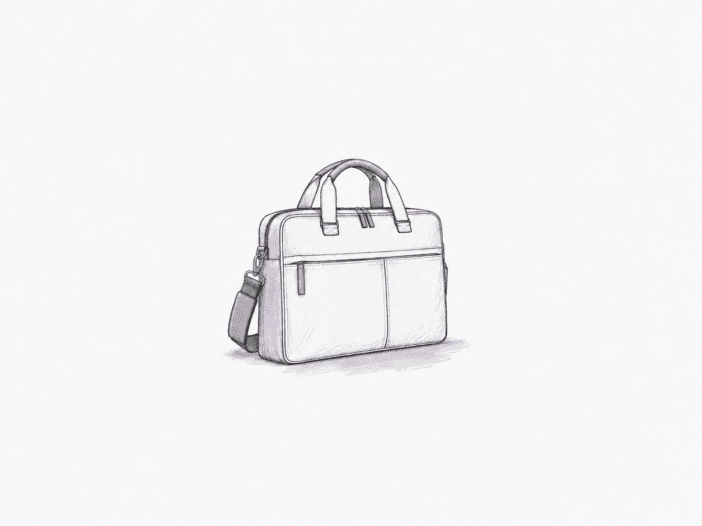
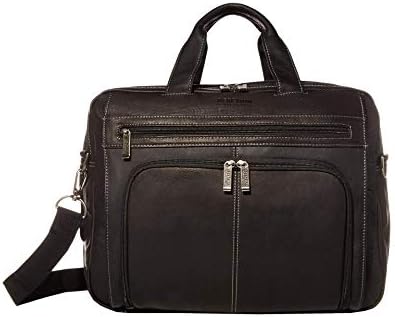
The Out of the Bag Manhattan earns its keep when you actually need the space: a 15 to 15.6-inch laptop, documents, a tablet, chargers, cables, and other work or travel gear. This bag is not built for minimal carry. It works best as an organized, expandable office-and-travel hauler.
The trade-off shows up as you add weight. Buyers like the capacity and compartment layout, but heavy shoulder carry, bulk, and zipper durability get more conditional as the load increases. If your setup is just a slim ultrabook and charger, you may end up carrying extra bulk for space you never use.
Product Snapshot
The question is whether you need this much space to put uput up with the bag’s bigger, load-sensitive profile.
| Product detail | Decision relevance |
| Briefcase / laptop portfolio | Best aligned with office, mobile-work, business-travel, and document-heavy setups rather than minimal carry. |
| Expandable multi-compartment layout | Supports substantial mixed loads of devices, files, chargers, books, and travel items. |
| Laptop evidence | 15–15.6-inch-class laptops are repeatedly supported; thickness still matters. Evidence for 16-inch laptops is mixed, and one 17-inch example reports no fit. |
| Travel interface | Buyer reports support underseat use and a luggage-handle sleeve, plus exterior access for travel documents. |
| Organization | A file/notebook divider section and multiple pockets are supported; no dedicated water-bottle pocket or key clip is established. |
| Leather and weather | Manufacturer Q&A describes full-grain Colombian leather and says it is not water resistant. One buyer reports a “Genuine Leather” interior label, so the material-grade wording is not fully reconciled. |
Buyer Evidence Metrics
The metrics point to four practical boundaries: device size, capacity versus portability, shoulder carry under load, and longer-term zipper friction.
| Buyer Question | Metric | Evidence |
| How clear is the laptop-size boundary around 15–15.6 inches? | UBC 0.77 | Moderate · n=13 |
| How often does high or expandable capacity appear with weight or bulk friction? | TCR 0.32 | Moderate · n=19 |
| Does shoulder-carry instability become more concentrated with a heavy or full load? | CFL 2.50× | Limited · n=5 |
| Does zipper friction become more concentrated in longer-term use? | CFL 2.50× | Limited · n=5 |
How these metrics work:
- Use Boundary Consistency (UBC) measures how consistently eligible buyer evidence separates a supported use case from the condition where that use becomes more limited or conditional.
- Trade-Off Coupling Rate (TCR) measures how often an observed product strength appears together with a specific friction among eligible buyer evidence. It does not establish causation.
- Context Friction Lift (CFL) measures whether a known friction is more concentrated in one eligible context than in the eligible comparison baseline. It is not a severity or failure-probability measure. For CFL, public n reflects the smaller eligible comparison group.
- n is the number of relevant, eligible, deduplicated buyer observations used for that metric—not the product’s total review count. These are buyer-evidence signals, not product-performance scores.
See how these buyer-evidence metrics work.
Fit–Friction Matrix
The bag fits best when you actually use its volume. Fit gets more conditional if device size, load weight, or portability matter more to you than raw capacity.
| Buyer Setup / Context | Fit Signal | Main Friction |
| 15–15.6-inch laptop + tablet/files + normal work accessories | Generally Works | Thicker laptops can make sleeve access tight even within the supported screen-size range. |
| High-volume tech and document load using the bag’s expandable capacity | Recurring Strong Fit | The same capacity can create more bulk and carry weight than some buyers want. |
| Business or air travel with laptop, travel documents, and roll-aboard luggage | Generally Works | Buyer reports support underseat use, but loaded weight can become the practical constraint. |
| Heavy or fully packed one-shoulder carry | Conditional Fit | Some buyers report tilt, twisting, slippage, or repeated adjustment; others report stable carry. |
| 16-inch-class laptop | Conditional Fit | Buyer evidence is inconsistent, so exact laptop dimensions and thickness matter. |
Capacity Is the Reason to Buy It—But Only If You Use the Space
This bag works best as a portable office, not a slim laptop sleeve. Most buyers pack a laptop, files, tablets, chargers, headsets, drives, books, and other work gear, leaving room to spare.
That extra space comes with a cost. The TCR 0.32 signal means high or expandable capacity and weight or bulk friction show up together in some buyer evidence. Capacity doesn’t cause the friction, but if you want the extra room, you need to decide whether you are comfortable carrying the added footprint and weight.
If you only carry an ultrabook, a charger, and a few small accessories, some buyers found the bag just felt too big.
Laptop Fit Is Strongest at 15–15.6 Inches
A 15- to 15.6-inch laptop is the safest fit, especially if the machine isn’t unusually thick. Buyers report success fitting a 15-inch MacBook Pro or 15.6-inch laptop along with tablets, files, travel items, and other accessories.
Fit gets less certain at 16 inches. Some buyers say a 16-inch machine fits, but others call it a tight squeeze. One 17-inch example did not fit.
UBC 0.77 does not mean a 77% chance that a laptop will fit. It means the eligible evidence is fairly consistent in separating the repeatedly supported 15–15.6-inch range from the more conditional larger-device range.
Shoulder Carry Becomes More Conditional as the Bag Gets Full
The strap does not always cause problems, but evidence gets mixed as the load increases. Some buyers report comfortable or stable shoulder carry, while others mention off-balance hanging, twisting, slippage, limited padding, or needing to readjust.
The CFL 2.50× signal means those shoulder-carry frictions are more concentrated in the heavy/full-load context than in lighter or unspecified shoulder-carry comparisons. It does not mean a heavily loaded bag is 2.5 times more likely to fail or become uncomfortable.
If you plan to use the bag’s full capacity every day, shoulder comfort matters more than it does for a moderate office load.
Long-Term Durability Is Mixed, Especially Around the Zippers
Buyer evidence does not support a simple yes-or-no on durability. Some multi-year users report strong daily or travel durability, including buyers who kept using the bag after years of regular use.
Other buyers report zipper failures after about two to two and a half years, sometimes with shoulder pad or stitching wear. The long-term zipper CFL of 2.50× means zipper problems show up more often in longer-term use than in shorter-use evidence, but the counterexamples still matter.
The practical takeaway: treat long-term zipper reliability as a real unknown, not a sure strength or a guaranteed failure.
What Buyers Carry With It
The most useful evidence comes from buyers who actually pack mixed loads, not just from isolated capacity claims.
| Observed setup | What worked | Friction or condition |
| 15-inch MacBook Pro + iPad + Bose headset + other travel items | One-bag tech carry with reported underseat use | No recurring friction established for this specific setup. |
| 14-inch Toughbook + thick padfolio + files + Wi-Fi pack + external drive + voice recorder | High organized capacity with room left over | The same long-term user reported repeated zipper repairs and shoulder-pad wear after daily use. |
| Laptop + iPad + Galaxy S7+ tablet + Kindle + passport wallet + phone + charger + cable organizer | Very high multi-device travel capacity | The buyer considered the bag heavy before loading and noted baggage-weight sensitivity. |
What Buyers Should Check Before Buying
The main checks are about matching the bag to your actual load, not just whether you like the look of a leather briefcase.
- Measure the laptop itself, especially at 16 inches. Screen size alone is not enough; thickness and chassis dimensions matter, and 16-inch evidence is mixed.
- Decide if you really need the volume. Buyers who carry lots of documents or multiple devices use the space well. If you only pack a compact ultrabook, the bag may feel too big.
- Test the bag at your actual loaded weight. Heavy or full shoulder carry is where complaints about tilt, twisting, slippage, and padding show up most often.
- Check zippers, seams, and exterior finish as soon as the bag arrives. Buyer evidence includes some initial defects and a real mix of long-term zipper outcomes.
- Plan for the organization gaps. There is no dedicated water-bottle pocket or key clip, so if you rely on those, you will need another solution.
- Do not expect rain protection or automatic upright stability. Manufacturer Q&A says the leather is not water-resistant, and buyer evidence links standing stability to balanced or low-centered packing.
The Kenneth Cole REACTION Out of the Bag Manhattan works best as a high-capacity work and business-travel briefcase with real organizational upside. Fit gets less convincing if you want minimal bulk, need a laptop bigger than 15.6 inches, or expect heavy shoulder carry and trouble-free long-term zipper performance.

Need the extra compartments—or would a smaller briefcase serve you better every day? Explore our Best Laptop Briefcases comparison to see how the Kenneth Cole stacks up against slimmer and more streamlined alternatives.
