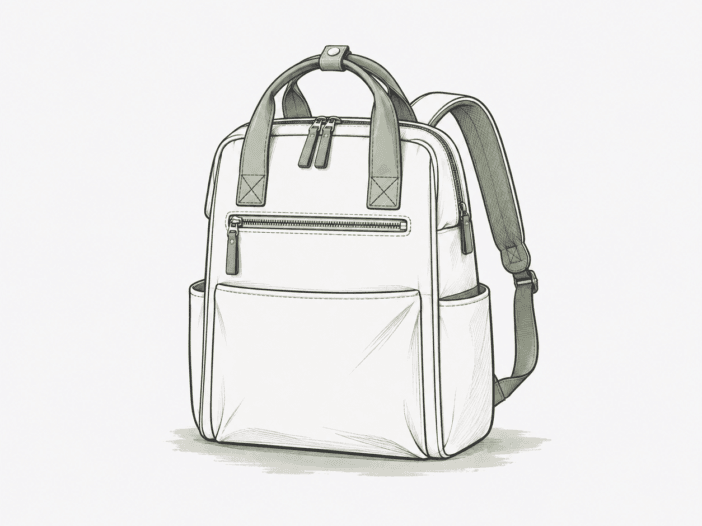
The Baggallini Soho Backpack fits best when you carry one laptop, your work essentials, and a few personal items. Buyers keep mentioning the self-standing shape and organized interior for office days, meetings, or travel where you can set the bag down and open it up on purpose.
The same structure that keeps the bag upright can slow you down if you want to reach in quickly or close it with one hand. Fill it up, and the side bottle pockets lose flexibility too. There’s no real evidence that size or configuration variants change this, so what matters is how you pack, how often you need fast access, and the actual size of your laptop and bottle.

Decision Snapshot
| Decision Area | What the Buyer Evidence Suggests | Main Boundary |
| Cleanest fit | One laptop plus charger, mouse, notebook/documents, phone, and small personal items | Heavier multi-device loads reduce the margin for comfortable, flexible carry |
| Organization | The structured, self-standing format works well when the bag is placed beside a desk, meeting chair, or airline seat | Fast one-handed access is less convincing because the framed top often needs deliberate opening or zipper alignment |
| Laptop fit | Reported successes include 13-inch, 15-inch/15.6-inch, and one 16-inch MacBook Pro example | Larger or taller devices become more conditional; one 17-inch example was snug and another taller laptop did not fit |
| Travel role | Repeated buyers used it as an underseat or personal-item-style bag with electronics and a restrained clothing load | Overpacking can make underseat placement harder, and airline fit should be verified for the packed bag |
| Bottle carry | Smaller or compatible bottles can work in the side pockets | Larger bottles or a full main compartment can consume the pocket space and make access difficult |
| Long-term confidence | Some buyers report sustained use with intact stitching and good overall function | Handle peeling/wear and zipper sticking or breakage recur often enough to merit inspection before purchase |
Does It Match Your Setup?
| Buyer Setup / Context | Fit Signal | Main Friction |
| One laptop + charger/mouse + notebook or documents for work | Recurring Strong Fit | Heavier additions can make the load feel noticeably less forgiving |
| Compact underseat travel load with laptop/electronics + light clothing or in-flight essentials | Generally Works | Overpacking reduces underseat flexibility; airline fit remains trip-specific |
| Bag set down beside a desk, meeting chair, or airline seat for organized access | Generally Works | The framed top works best when fully opened and positioned rather than accessed in motion |
| Frequent one-handed or on-the-go top access | Limited Fit | Multiple buyer reports describe two-handed opening/closing, setting the bag down, or aligning the frame |
| Smaller bottle + moderately filled main compartment | Conditional Fit | Larger bottles and fuller packing can restrict the side pockets |
| 16–17-inch-class or unusually tall laptops | Conditional Fit | Reported outcomes conflict, so screen diagonal alone does not establish fit |
Structure isn’t just good or bad. The Soho’s structure helps if it matches your routine, but it can get in the way if you need speed, more space, or have a device that’s right at the edge of fitting.
The Structured Top Works Best When the Bag Can Be Set Down
Several buyers valued the Soho because it stands upright and keeps its contents visible when placed beside them. Meeting and conference users specifically described the benefit of setting the bag down, opening it, and reaching documents or work items without the bag collapsing.
That benefit flips if you need to get in and out of the bag differently. Buyers often mention needing both hands to open or close the top, stretching the corners all the way, or setting the bag down before the zipper works smoothly. One person liked the stiff opening; another found it limiting. So the trade-off depends on your routine, not a universal flaw.
If you’re moving from desk to meeting, the structure can help. If you’re reaching in while walking, standing, or juggling something else, quick access becomes the bigger issue.
Laptop Fit Becomes Conditional at the Larger End
The buyer evidence supports a useful middle range without establishing a universal screen-size rule. Reported successes include a 13-inch laptop, 15-inch and 15.6-inch machines, a load containing both 15-inch and 14-inch laptops, and one 16-inch MacBook Pro.
The upper limit is less clear. One buyer said anything over 15 inches felt tight, another squeezed in a 17-inch laptop but only just, and someone else returned the bag because a taller laptop would not fit. These cases don’t align with the 16-inch success, since screen size alone doesn’t indicate the real height, width, thickness, or sleeve bulk.
The practical step is to measure your laptop and any sleeve you plan to use. Buyer evidence does not support treating 16-inch or 17-inch as a guaranteed fit.
Bottle Space Shrinks as the Main Load Expands
The Soho’s side pockets work, but how well depends on what else you pack. Buyers have used smaller bottles and some specific drinkware without trouble, but bigger bottles and a full main compartment often make things harder.
Some buyers say 32-ounce bottles are too big, a 25-ounce or 750 ml bottle can be awkward, and bottles get hard or impossible to insert once the bag is full. Others have carried bottles successfully, even a larger one, so there’s no clear line.
That mix of results is useful. The real limit isn’t just bottle size. Shape, height, and how much space is left inside all matter.
Compact Air Travel Works Better Than Maximum-Capacity Travel
Multiple buyers used the Soho under an airline seat with a laptop or tablet, chargers, travel essentials, and a limited amount of clothing. Specific reports include a three-week trip to Portugal, travel to Japan, an Atlanta-to-San Diego trip, and one buyer who used it for personal items on Play Airlines, United, Virgin, SAS, and Air France.
These examples don’t prove the bag always fits airline rules. One buyer said overpacking made it tough to slide under the seat, and others found the overall capacity smaller than a typical roomy backpack.
The trolley sleeve helps for travel, but even that has a limit. One buyer found it tight over an Away suitcase handle. For air travel, the evidence points to a compact, electronics-first personal-item role, not a max-capacity carry-on replacement.
Evidence Signals
| Buyer Question | Practical Reading | Evidence Signal |
| Does quick access become more problematic when one-handed or on-the-go use is the priority? | Yes. Two-handed or set-down access friction becomes much more concentrated in that context, although the evidence base is limited. | CFL 5.50× · Limited · n=5 |
| Is the self-standing structure always tied to access friction? | No. Structure is often useful when the bag is set down; only part of the structure-positive evidence also reports the paired opening friction. | TCR 0.33 · Moderate · n=9 |
| Is there a real bottle-pocket boundary? | Yes, but not a hard size cutoff. Larger bottles and fuller internal packing are more often where friction begins, with some contradictory successes. | UBC 0.86 · Moderate · n=14 |
| Does laptop fit become less predictable toward larger/taller devices? | Yes. The available examples separate the cleaner mid-size fits from more conditional larger-device cases, but a 16-inch success prevents a simple diagonal-size rule. | UBC 0.83 · Limited · n=6 |
- CFL: whether a known friction is more concentrated in a defined context than in the eligible baseline; it is not a severity score.
- TCR: how often an observed strength appears together with a specific friction among eligible buyer evidence; it does not establish causality.
- UBC: how consistently eligible buyer evidence separates a supported use from the condition where it becomes more limited or conditional.
- n: relevant, eligible, deduplicated buyer observations used for the metric—not the product’s total review count. For CFL, public n is the smaller eligible comparison group.
These are buyer-evidence signals, not product-performance scores or probabilities. See how these buyer-evidence metrics work.
Real Buyer Loadouts Show Where the Bag Stays Practical
These examples show observed use, not guaranteed capacity templates.
Office one-bag setup
Laptop · charger · mouse · planner/notebook · phone · bottle · coffee mug · lunch
One buyer used that setup instead of carrying two or three bags. That supports the Soho as a one-bag work option, but heavier or tightly packed loads still cut down bottle-pocket and carry flexibility.
Multi-device work setup
15-inch laptop · 14-inch laptop · tablet · accessories · notebook
A buyer fit this load so that the bag can handle more than just a single laptop in some cases. That’s not a general promise for multi-device carry, since other buyers say the bag gets heavy or restrictive with more gear.
Compact personal-item setup
Laptop · small packing cube · in-flight essentials
One long-term owner used this setup on several airlines and said it worked well under the seat. The key is not overpacking. The same buyer mentioned limited capacity and said fuller loads make the side pockets less useful.
Why Some Buyers Look Toward Roomier or More Padded Alternatives
| Compared Product / Type | What Mattered | What Shifted the Choice |
| Traditional Jansport backpack | Open roominess | One buyer described the Soho as notably less roomy, making the traditional backpack the clearer reference for larger loads |
| l0v3v00k backpack, as named by the buyer | Pocket count, strap width/padding, and price | That buyer switched away from the Soho because the alternative better matched comfort, organization, and value priorities |
| Swiss Army backpack | Overall carry size for travel/day use | One buyer replaced the previous backpack with the Soho and preferred the smaller, less overstuffed-feeling travel setup |
These comparisons don’t pick a universal winner. They show what made some buyers choose or skip the Soho: a compact structure and professional look on one side, and roominess, padding, or price on the other.
Long-Term Feedback Is Mixed Enough to Check the Current Hardware
Some owners have good things to say: about a year with no rips, almost two years with stitching still holding, and an older bag from the same family still working after several years.
But several reports mention peeling or wear, and some buyers mention sticking or broken zippers. Others say their zippers are fine, so the evidence doesn’t support a blanket durability claim.
Since some long-term feedback is about older or nearly identical bags, don’t assume every current version uses the same handle or zipper build.
What Buyers Should Check Before Buying
- Measure the laptop chassis, not just the screen diagonal. Larger-device reports conflict, and the available evidence does not support a universal 16- or 17-inch fit claim.
- Decide how often you need one-handed access. If you regularly open and close the bag while standing or moving, the framed top is the most consistently reported functional friction.
- Try your actual bottle with a realistic load. Larger bottles and a full main compartment are the conditions most often associated with side-pocket problems.
- Verify the current empty weight. The available sources contain conflicting weight information, and buyer perception ranges from light to heavy.
- Inspect the current handles and main zipper construction. Long-use successes coexist with recurring handle wear and some zipper failures or sticking.
- Check airline rules against the packed bag. Repeated underseat success is encouraging, but buyer-specific trips do not establish universal personal-item compliance.
Baggallini Soho Backpack on Amazon
Compare its role with other backpacks, totes, and slings in our guide to Baggallini Tech Carry.
