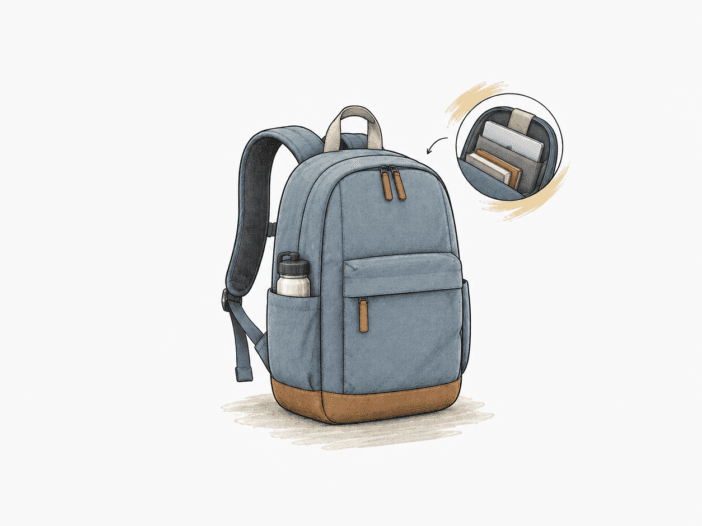
The JanSport SuperBreak Plus works for buyers who carry a simple load: a laptop or Chromebook, a few notebooks, folders, maybe a binder, and daily essentials. Most buyer reports focus on school and everyday use. Buyers describe the bag as lightweight, easy to pack, and roomy enough for a standard student setup.
Fitting everything inside does not always mean the bag carries comfortably. Some buyers handled dense school loads without trouble. Others reported shoulder discomfort, a flexible back panel, or a heavy-feeling carry once books and rigid items stacked up. The SuperBreak Plus works best for simple or moderate daily loads. Buyers who need real structure for heavy daily carry should look elsewhere.
Device fit follows the same pattern. Buyers report that a 13-inch Dell work laptop and a 15-inch laptop fit the sleeve. A 16-inch Acer Predator gaming laptop did not fit the padded section, and a 17-inch laptop did not fit the internal pocket. These examples help with pre-purchase checks, but the sample for larger devices is too small to set a universal screen-size rule.
Buyer evidence does not show any decision-relevant SuperBreak Plus variant. Color and print differences are cosmetic. The real decision is about your load, device fit, bottle fit, organization needs, and body fit—not picking between proven configurations.

Product Snapshot
Buyer reports describe a simple layout with a few practical features, not a highly segmented carry system:
- Open main storage plus front organizer: Most buyers mention a main compartment with a smaller front pocket or organizer. This layout keeps packing flexible. Buyers who want more internal separation may find the layout too basic.
- Internal laptop sleeve: The sleeve sets the Plus apart from the regular SuperBreak in buyer comparisons. Buyer examples show better support for smaller laptops than for larger gaming or 17-inch devices.
- Padded adjustable shoulder straps: Many buyers report good comfort. Comfort gets less consistent with denser loads or certain body types.
- Side bottle pocket: Most buyers report one side pocket, but some mention different pocket setups. Bottle fit is more predictable with smaller bottles. Fit with 32 oz bottles is less certain.
- Flexible back and bottom structure: Buyer evidence does not show a padded bottom. Several buyers point to limited rigidity. This matters when hard or bulky items press against your back or change how the bag sits.
Buyer Evidence Metrics
| Buyer Question | Metric | Evidence |
| Does shoulder discomfort become more concentrated with dense school loads? | CFL 1.60× | Limited · n=4 |
| Can durability-positive use still come with zipper-cover snagging? | TCR 0.50 | Moderate · n=8 |
| Is bottle fit more predictable at 16–26 oz than at 32 oz? | UBC 0.83 | Limited · n=6 |
| Does the laptop sleeve show a larger-device fit boundary? | UBC — | Very Limited · n=3 |
How these metrics work: Context Friction Lift (CFL) measures whether a known friction is more concentrated in a defined eligible context than in the eligible baseline; for CFL, public n reflects the smaller eligible comparison group. Trade-Off Coupling Rate (TCR) measures how often an observed product strength appears together with a specific friction among eligible buyer evidence. Use Boundary Consistency (UBC) measures how consistently eligible buyer evidence separates a supported use case from the condition where that use becomes more limited or conditional. n is the number of relevant, eligible, deduplicated buyer observations used for that metric—not the product’s total review count. These are buyer-evidence signals, not product-performance scores. See how these buyer-evidence metrics work.
The CFL 1.60× result does not mean you are 1.6 times more likely to get shoulder pain. In this evidence set, shoulder discomfort shows up more often in dense school loads than in compact or light laptop loads. The signal is mixed. Some dense-load buyers still reported comfortable carry, and one lighter-load buyer reported discomfort below 5 pounds.
The TCR 0.50 result points to a recurring trade-off, not a universal defect. Among eight durability-positive buyer reports that mention zipper behavior, half said the protective fabric around the zipper snagged. The other half reported smooth or trouble-free zippers.
The UBC 0.83 bottle signal marks a practical boundary in buyer evidence. Bottles in the 16–26 oz range fit more consistently. Reports on 32 oz bottles conflict. The laptop-sleeve boundary is also useful, but only three eligible observations support it, so we left the number out.
Fit–Friction Matrix
| Buyer Setup / Context | Fit Signal | Main Friction |
| Laptop or Chromebook + notebooks/folders + binder(s) + small daily essentials for school | Generally Works | Shoulder comfort becomes more mixed as the load becomes denser or heavier |
| Compact 13–15 inch laptop-centric carry with light paper or accessories | Generally Works | One long-term buyer still reported shoulder/back discomfort below 5 lb, so comfort is not universal |
| Larger laptop that must fit the padded sleeve, including the cited 16-inch Acer Predator or 17-inch example | Specific Example Only | The cited larger devices did not fit the padded section/internal pocket; evidence is too sparse for a universal size cutoff |
| Side-pocket bottle carry, especially 16–26 oz versus 32 oz | Conditional Fit | Smaller examples are more consistently workable; 32 oz outcomes conflict and taller bottles may be less secure |
| Airline personal-item or international daypack use | Conditional Fit | Successful examples exist, but compliance depends on airline rules and how fully the bag is packed; Frontier compliance is not established |
| Taller or larger wearer who needs substantial strap extension | Conditional Fit | Several buyers report limited strap length or a visually small fit on a taller body |
How Buyers Use It
School is the strongest recurring use case.
Most buyer reports focus on school use. Buyers describe loads ranging from a Chromebook with basic supplies to denser setups with binders, notebooks, folders, pencil bags, and a computer.
The real decision point is not just whether those items fit. Buyer evidence points to a more useful split:
- Simple or moderate school loads: generally align with the bag’s lightweight, open layout.
- Dense school loads: These can still fit, but shoulder comfort and back support get less consistent as the load gets heavier.
- Heavy books or rigid contents: These matter more because several buyers report limited structure between the load and your back. Hard or bulky items can press against your back if the bag flexes.
This trade-off makes the SuperBreak Plus a better fit for buyers who want simple packing. Buyers who need a structured load-hauling backpack should look elsewhere.
Light work and college carry follow the same pattern.
Lighter work and college setups usually mean one laptop, a few papers, and small accessories. These loads fit the bag’s simple format without stressing the structure.
Buyer evidence does not show a separate work-oriented setup. The same trade-off applies. The bag supports a modest daily load better than a consistently dense one.
Travel is real, but airline fit is not universal.
Travel use comes up often enough to matter. Buyer evidence only supports it conditionally, not for every buyer.
Examples in the feedback include:
- a buyer who used the bag during a three-week trip to Japan;
- a buyer who used it as a medical/day bag on a long international trip and said it met restrictive personal-item limits on some Asian airlines only when not filled;
- buyers who describe international or airline use as a personal item.
These examples show travel use is possible. They do not prove universal airline compliance. The Frontier Q&A does not confirm that the airline’s personal-item rules apply to this backpack. Treat airline fit as conditional, not guaranteed.
What Buyers Carry With It
The most useful evidence is not a generic capacity number. It is the actual loads buyers describe that show what fits and where the limits sit.
- 15-inch laptop plus everyday essentials: One buyer said this setup fit securely and stayed lightweight and comfortable. This supports a smaller-laptop use case, not a universal laptop-size claim.
- 16-inch Acer Predator plus headset, power brick, USB hub, Razer DeathAdder, two 1 TB Lexar LS500 SSDs, and Thunderbolt cables: One buyer carried this full tech setup in the bag, but the laptop itself did not fit the padded section.
- Chromebook plus school supplies: Repeated school-use reports support this kind of everyday load. The main boundary is not storage volume alone. Denser packing makes shoulder comfort less predictable.
- Large binder, four notebooks, folder, computer, and two pencil bags: One high-school buyer said the load fit, but the bag got heavy, and the shoulder padding felt tougher with that setup. Heavy loads push the padding to its limit.
- 26 oz Yeti, 24 oz ThermoFlask, 32 oz HydraPeak: Named bottle examples show larger bottles can work in some units, but other 32 oz reports conflict. Treat 32 oz fit as uncertain. Check your bottle against the pocket before buying.
Long-Term Use Patterns
Buyer evidence on durability is real but mixed. Some buyers report years of use, while others describe early wear or failure.
Several buyers report multi-year school or everyday use, repeat purchases after long service, and material or stitching that held up to routine abuse. One long-term reviewer described years of travel and daily carry with no tears or rips.
Negative evidence is concrete too. Separate buyers report:
- straps or seams separating after months of use;
- tearing inside the bag;
- a front-pocket hole within a school year;
- bottom failure after long-term ownership.
The most repeatable friction is the zipper-cover fabric. Several durability-positive buyers say the protective fabric lip can catch in the zipper path. Other durability-positive buyers report smooth zippers. Buyer evidence supports a recurring snag risk, not a claim that the zippers always fail. If possible, check the zipper path on your unit.
What Buyers Should Check Before Buying
- Check your exact laptop against the sleeve. Buyer evidence shows a 13-inch work Dell and one 15-inch laptop fit, while a 16-inch Acer Predator gaming laptop and a 17-inch laptop did not fit the padded or internal sleeve. The sample for larger devices is very small. Measure your device’s actual dimensions, laptop plus case, not just the screen size.
- Judge your load by density, not just capacity. Buyer evidence shows the bag can hold binders, notebooks, folders, computers, and accessories. Shoulder comfort gets less consistent as books and rigid items make the load denser.
- Treat 32 oz bottle fit as conditional. Buyer evidence for 16–26 oz bottles is more consistent. Reports on 32 oz bottles conflict. One buyer notes taller bottles can slip from the side pocket.
- Check the actual bottle-pocket setup on the unit you are considering. Most buyers report one side pocket, but some mention no pocket or two pockets. Buyer evidence does not show why these units differ. Confirm the pocket count before buying if bottle carry matters to you.
- Pick this bag for simple organization, not deep compartmentalization. The open main compartment and front organizer work for buyers who want flexible packing. If you need a key tether, several exterior pockets, or more rigid internal separation, the layout will feel limited.
- Check strap length and body fit if you are tall or broad. Several buyers report limited strap extension or a small fit on taller wearers. Others describe the straps as comfortable. If possible, try the bag loaded before buying.
